
Daniel 7
King James Version · 28 verses · tap a verse for its study panel
Listen to Daniel 7
The full chapter read aloud in a natural voice.
What the verse says and what it means. One reading, no tabs. Saved in this browser.
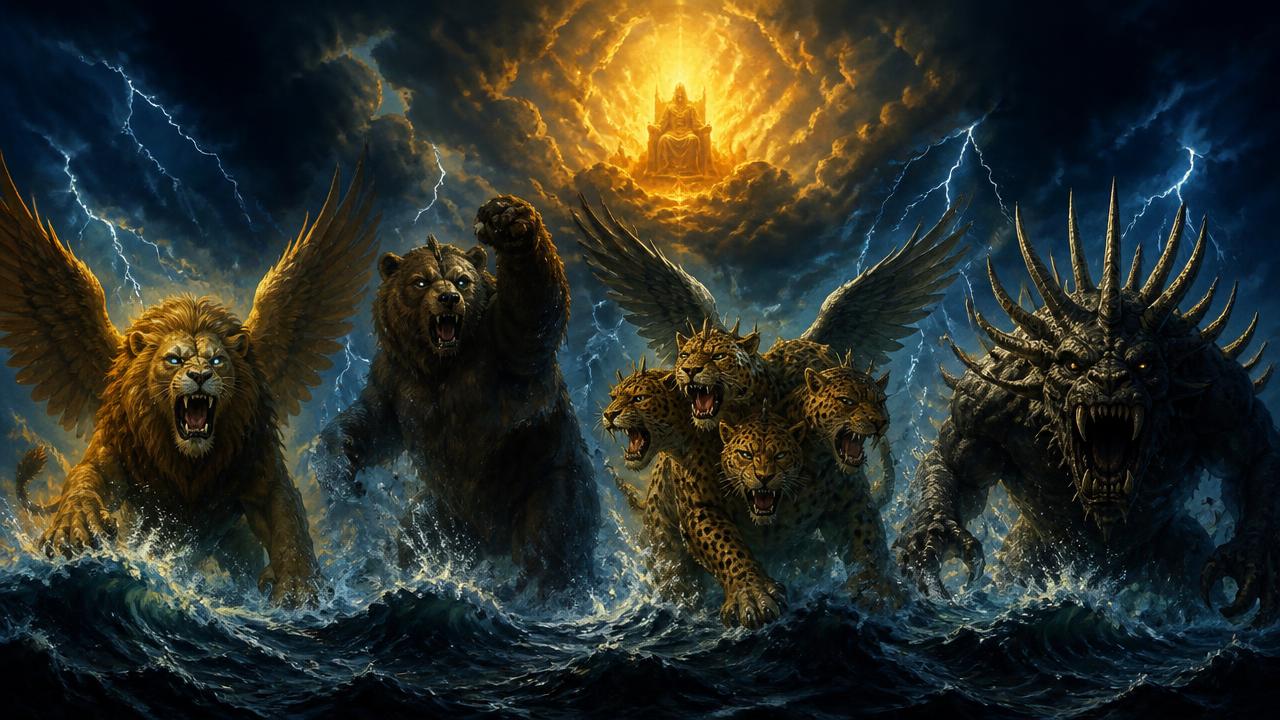
The chapter exposition
Daniel 7 — seen whole
The chapter read as one picture before any verse is opened: what the scene shows, where it sits in the continuous story, and the chain references that hold it to the rest of Scripture.
2.7 Daniel 7 — The Night Vision: Beasts, the Little Horn, and the Court in Session
The history of the vision. Belshazzar’s first year (~553 BC) — before chapters 5 and 6 in time. Daniel dreams: the four strive on the great ; four rise.
The sequence, enlarged. - Lion with eagle’s — (Jer 4:7; 50:17): the winged lions of its own palace reliefs; wings plucked, a man’s heart given — Nebuchadnezzar’s humbling written into the emblem. - Bear raised on one side, three ribs in its mouth — Medo-Persia, the Persian side dominant; the ribs its three great conquests (Lydia, Babylon, Egypt). “Arise, devour much flesh.” - Leopard with four wings and four heads — Greece: Alexander’s speed (wings doubled), and at his death the empire’s four-fold division (Cassander, Lysimachus, Seleucus, Ptolemy) — four heads that Daniel 8 will re-draw as four . - The fourth , dreadful and terrible, iron teeth — Rome, unlike all before it; it devours and breaks in pieces; and it has ten horns — the divided nations of Europe (the toes of ch. 2), among the principal of which history counts the Alemanni, Franks, Anglo-Saxons, Burgundians, Lombards, Suevi, Visigoths, Heruli, Vandals, Ostrogoths.
The — the center of the chapter and of the book. “There came up among them another little horn, before whom there were three of the first plucked up by the roots: and, behold, in this horn were eyes like the eyes of man, and a mouth speaking great things” (7:8). The specifications, assembled from vv. 8, 20–21, 24–25:
Rises among the ten — in Western Europe, not the East.
Rises after them — after AD 476.
Uproots three — the three Arian powers that stood in its way were extirpated: the Heruli (493), the Vandals (534), the Ostrogoths (538, driven from Rome). ⚑ One deck lists “Ostrogoths, Visigoths, Heruli” — see Flag 11a; the position adopted here is the standard listing.
Is diverse from the others — not merely a state: a church wielding a state.
Has eyes of a man and a great-speaking mouth — a seeing, speaking, claiming power: “Blasphemy is putting oneself in the place of God… we’re looking for a religious power that would be a mingling of church and state that would rise after the fall of the Roman Empire” (Photo-Theology, Jul 6, 2026).
Makes war with the saints and prevails — the long persecution of dissent, from the Vaudois valleys to Smithfield.
Thinks to change times and laws — the tampering with the fourth commandment; Rome’s own catechisms claim the change of Sabbath to Sunday as the mark of her authority (Keenan’s Catechism; Geiermann’s Convert’s Catechism: “We observe Sunday instead of Saturday because the Catholic Church transferred the solemnity”; Enright’s public challenge; the Decretalists’ “the Pope has power to change times”).
Holds the saints “a time and times and the dividing of time” — 3½ prophetic times = 1260 prophetic = : AD 538 (Justinian’s arms make the decree of 533 effective; the Ostrogoth siege broken) to 1798 (Berthier enters Rome; the pope dies in exile). “This deadly wound happens exactly 1,260 years after it first got its power” (Jul 6, 2026).
Only one power in history satisfies all eight: papal Rome. And the identification is made with a crucial pastoral clarification, constant across the corpus: this is a system being identified, never the individual Catholic believer — “God has precious people in every communion, and the final call is ‘Come out of her, my people,’ which is only addressed to people He calls His.”
The heaven-side mirror: the uproots three of ten — a third — as the drew “the third part of the of heaven” (Rev 12:4). “You’re probably thinking about what Lucifer did in heaven… He would dominate under a disguise of holiness, just as Lucifer did in heaven” (Jul 6, 2026). The earthly career of the horn is Lucifer’s war filmed on earth.
The — the part the exist to frame. “I beheld till the thrones were cast down, and the Ancient of did sit… the judgment was set, and the books were opened” (7:9–10). Before the Son of man receives the kingdom, a court convenes: ten thousand times ten thousand attend; records are opened; and “one like the Son of man came with the clouds of heaven, and came to the Ancient of days” — not to earth; to the Ancient of days — “and there was given him dominion, and glory, and a kingdom” (7:13–14). This is the pre-advent, investigative judgment — the same event Daniel 8 will date and Revelation 14:7 will announce (“the hour of his judgment is come”). The chapter’s comfort is judicial: “judgment was given to the saints of the most High” (7:22) — the court finds for them.
Christ connection. The Son of man — Jesus’ favorite self-title, drawn from this scene and quoted by Him to Caiaphas at His own trial (): the Prisoner notifying the judge that their roles will reverse.
Chain references. Rev 4–7 (the ten-words pairing: the throne room and the sealed book) · Rev 12:3–4, 14 (the 1260 from heaven’s side) · Rev 13:1–10 (the as ) · Rev 14:6–7 · .
Drawn from the same framework published on The Foundations.
How this chapter is read
The symbol keys and study principles that govern this chapter. Every conclusion is checked against Scripture — follow the references and read them for yourself.
Symbol keys · 17
Babylon
A wild beast, symbolizing oppressive powers
Basis: Daniel 7 describes Babylon as a lion, representing its role as a dominant empire
Beast
Powers opposing God's truth
Basis: Daniel 7's depiction of beasts representing kingdoms
Beast
A power or kingdom lacking understanding of God's Word
Basis: Daniel 7 describes kingdoms as beasts, and Nebuchadnezzar's transformation illustrates the lack of understanding associated with a beast's heart
The little horn
A power that arises after the fall of Rome, representing both pagan and papal Rome
Basis: The consistent representation of the little horn across Daniel 7 and 8
Little horn
Papal Rome
Basis: Daniel 7:8, 8:9
The little horn
a power that arises after the Roman Empire and opposes God's people
Basis: The interpretation of the little horn in Daniel 7 and 8
Little horn in Daniel 7 and 8
A power that opposes God and persecutes His people
Basis: The little horn's actions and characteristics are detailed in both chapters, showing its role in the prophetic timeline
Clouds
The presence of God and the prayers of the saints
Basis: Leviticus 16 describes the high priest entering with clouds of incense, paralleling the Son of Man coming with clouds in Daniel 7
Beasts in Daniel 7
Powers that attack God's law and truth
Basis: Daniel 7 describes beasts that change times and laws, representing opposition to God's word
Little horn
A power that arises after the division of the Roman Empire, characterized by persecution and blasphemy
Basis: Daniel 7:8, 21-22
Ancient of Days sitting
The commencement of a heavenly judgment scene
Basis: Daniel 7:9-10, linked to the Day of Atonement imagery in Leviticus 16
Little horn
Rome, both pagan and papal
Basis: The little horn in Daniel 8 parallels the little horn in Daniel 7, representing Rome
Little horn
Papal Rome
Basis: Described as a power that starts small but becomes strong, paralleling the little horn in Daniel 7
Lion
Babylonian empire
Basis: Daniel 7's depiction of the lion as a symbol of Babylon
Lion, Bear, Leopard, Dragon
Babylon, Medo-Persia, Greece, Rome
Basis: The sequence of beasts in Daniel 7 parallels the sequence of kingdoms in Daniel 2
Little horn
Rome
Basis: Parallels with the little horn in Daniel 7 and the fourth beast
Beast rising from the sea
A composite kingdom with characteristics of past empires, representing a future global power
Basis: The beast in Revelation 13 combines elements from the beasts in Daniel 7, indicating a unified power
Study principles · 42
The dimensions of biblical interpretation include literal, Christ, personal, church, and heavenly perspectives. These dimensions help in understanding the scripture's multifaceted applications, from historical to personal spiritual growth.
Prophecies can reveal insights into human character and spiritual growth. Understanding prophecies in a personal dimension helps in applying biblical lessons to individual lives.
Each chapter of a biblical book can be viewed through multiple dimensions to uncover different layers of meaning. This approach allows for a deeper understanding of the text by considering its implications on various levels, such as personal, church, and cosmic.
Summarize complex prophetic chapters with a single word to capture the essence of the chapter. This helps in remembering and understanding the overarching themes and connections between different parts of the prophecy.
Recognize the attack on key elements of faith (truth, sanctuary, Christ, etc.) as a recurring theme in prophecy. Understanding these attacks helps to see the broader narrative of the great controversy.
The principle of 'repeat and enlarge' is key to understanding the prophetic sections of Daniel. This principle shows how each subsequent vision in Daniel builds upon and expands the details of the previous ones.
The principle of repeat and enlarge helps to understand prophetic sequences by showing how different visions cover the same historical periods with increasing detail. This principle is evident in the book of Daniel, where successive chapters repeat the same historical timeline with additional details.
Prophetic symbols often represent nations or powers, with beasts symbolizing nations. In both Daniel and Revelation, beasts are used to symbolize nations or empires.
Prophecies in Daniel are repeated and expanded upon in subsequent chapters. Each chapter in Daniel builds upon the previous ones, adding more detail to the prophetic narrative.
Trust in God's prophecy as evidence of His control over the future. Prophecy serves as a reassurance that God is in control and that His promises are reliable.
God's judgment involves the vindication of the righteous and the restoration of truth. The prophetic narrative shows a pattern of God defending His people and cleansing the sanctuary from defilement.
Dan 7:22Psalm 74:22The identity of prophetic symbols is crucial for understanding the timeline of events. Identifying who or what a symbol represents helps establish the chronological context of the prophecy.
The principle of repeat and enlarge is key in interpreting prophetic texts. This principle indicates that later prophecies provide more detail about earlier ones, allowing for deeper understanding.
Symbols in prophetic literature often represent the same entities across different passages. Recognizing the continuity of symbols helps clarify the meaning of prophetic messages.
Understanding the historical context of a prophecy is crucial for accurate interpretation. Identifying the empires involved helps clarify the timeline and significance of the prophecy.
The actions of prophetic powers, such as the little horn, provide insight into the nature of judgment. These actions reveal the spiritual conflict and the battle over truth.
Judgment is a necessary process for understanding God's justice and mercy. It allows the redeemed to see God's fairness in dealing with every soul, ensuring that no one is lost without opportunity.
Daniel 7:9-10Psalms 51:4The investigative judgment precedes the millennial judgment, allowing for a thorough examination of the righteous. This sequence highlights the importance of understanding who is deemed worthy before the final judgment occurs.
The pattern of 'repeat and enlarge' is essential for understanding the structure and prophecies of the book of Daniel. This pattern reveals how each chapter builds upon the previous one, providing more detail and insight into the prophetic timeline.
The 'repeat and enlarge' principle in prophecy means that subsequent visions build upon previous ones, adding more detail without changing the foundational message. This principle helps to understand the structure of the book of Daniel, where each chapter provides more detail about the prophetic timeline first introduced in Daniel 2.
The visions in the book of Daniel span thousands of years and culminate with global events, not local ones. Each vision in Daniel ends with events that involve the entire world, such as the second coming of Christ, rather than local historical events.
The prophetic chapters of Daniel are interconnected and deal with the same historical powers. Daniel 2, 7, 8, 9, and 11 all reference the same sequence of kingdoms, showing a unified prophetic narrative.
The principle of repeat and enlarge is key to understanding prophetic books like Daniel. This principle shows that subsequent prophecies build upon and expand the details of earlier ones.
Prophecies in the book of Daniel are on a global scale, unlike other prophets whose prophecies were more localized. Daniel's visions consistently extend to the end of time, indicating a broader scope.
Symbols in prophecy often have consistent meanings across different passages. Understanding the consistent use of symbols like clay and iron helps to interpret the broader message of the prophecy.
Prophetic books like Daniel use a 'repeat and enlarge' method to provide more detail on earlier visions. This method allows for a deeper understanding of the prophecy as more details are revealed in subsequent chapters.
The visions in Daniel highlight attacks on key aspects of God's kingdom, while the visions in Revelation provide God's responses to these attacks. This principle is based on the thematic parallels between the books of Daniel and Revelation, where each vision in Daniel is countered by a corresponding vision in Revelation.
Prophetic sequences in Daniel are chronological and interconnected, each chapter building upon the previous. The visions in Daniel follow a sequence that prepares the reader for the next revelation, ensuring a cohesive understanding of prophecy.
Judgment scenes in prophecy are often linked to specific historical events and should be understood in their chronological context. The judgment in Daniel 7 occurs after the rise of the little horn, indicating a post-cross, pre-second coming event.
Use the principle of 'repeat and enlarge' to understand prophetic chapters. Each chapter in Daniel builds on the previous ones, providing more detail.
Identify transition points to understand the flow of prophetic events. Transition points mark the change from one kingdom to another, helping to map the narrative.
The destruction of the little horn is described as occurring without human hand, indicating divine intervention. This aligns with the destruction of powers in Daniel 2 and 7, which are also described as being destroyed by divine means.
The principle of 'repeat and enlarge' is used to understand prophetic sequences in Daniel and Revelation. This principle helps identify how each vision builds upon the previous one, adding more detail.
Prophetic timelines such as the 70 weeks, 1260 days, and 2300 days provide a framework for understanding historical and future events. These timelines anchor the prophetic narratives in specific historical contexts.
Prophetic symbols often represent historical powers or events, and their interpretation requires understanding their scriptural and historical context. The dragon in Revelation 12 is linked to the Roman Empire and Satan, showing how symbols can represent both earthly powers and spiritual forces.
The book of Daniel emphasizes the power of anti-Christian entities, while Revelation provides the counteraction through God's church and the ultimate victory of God's kingdom. Daniel focuses on the rise and actions of anti-God powers, while Revelation reveals the church's role and God's ultimate triumph.
Symbols in prophecy can represent historical and spiritual deviations from true religious principles. The ten horns are interpreted as perversions of Christianity, showing how religious movements can stray from their original intent.
Prophecies in the book of Daniel are interconnected and should be understood as part of a continuous narrative. The prophecies in Daniel 2, 7, 8, and 9 all feature the same sequence of kingdoms and events, suggesting a 'repeat and enlarge' pattern.
The principle of 'repeat and enlarge' is used throughout the book of Daniel, where each subsequent vision builds on the previous ones with more detail. This principle helps in understanding the continuity and expansion of prophetic events across the chapters.
Prophetic symbols in Daniel often represent the same powers across different chapters, even if the symbols themselves change. This consistency allows for a clearer understanding of the prophetic narrative and the identification of historical powers.
Transition points in prophetic chapters indicate shifts in historical powers or significant events. Identifying these points helps to map the progression of prophecy and align it with historical events.
Historical prophecies reveal patterns of persecution and the rise of powers that seek to unite church and state. The prophetic visions in Daniel illustrate how earthly kingdoms interact with spiritual authority, leading to conflict and compromise.
Daniel 7 — the full dossier
The long-form file on this chapter: the history behind it, the earlier Scripture standing under it, its symbols and chain references, where its principle is visible today, and the objections that attach to it. Three registers are kept distinct — documented history, internal biblical parallel, and interpretive correspondence.
The dossier is research-grade and runs 1,500 to 2,500 words. It opens at the Scholarly reading level, alongside the Old Testament roots, the present-day threads and the objections.