Revelation 13
King James Version · 18 verses · tap a verse for its study panel
Listen to Revelation 13
The full chapter read aloud in a natural voice.
What the verse says and what it means. One reading, no tabs. Saved in this browser.
The chapter exposition
Revelation 13 — seen whole
The chapter read as one picture before any verse is opened: what the scene shows, where it sits in the continuous story, and the chain references that hold it to the rest of Scripture.
3.7 Revelation 13 — The Two Beasts: The Image, the Mark, and the Dragon’s Voice
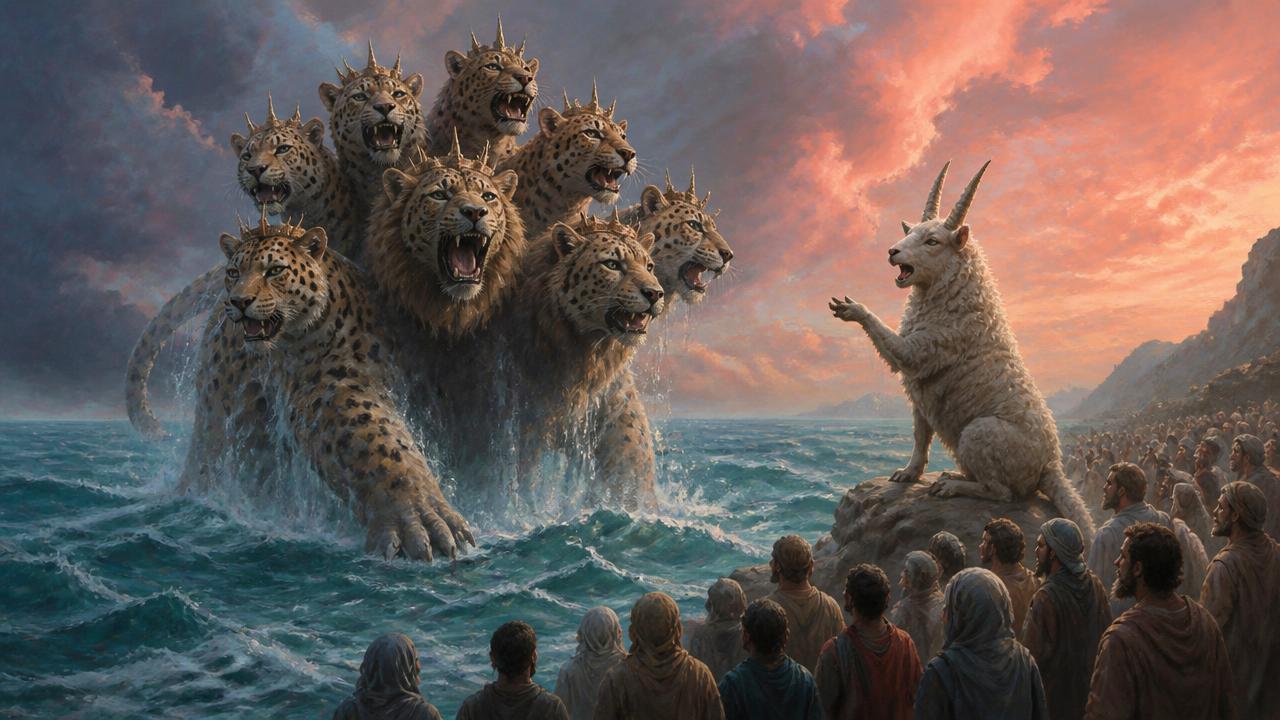
The (13:1–10). Rising from the sea (peoples, multitudes — populous Europe), a composite of Daniel 7 run in reverse — leopard body, bear feet, lion mouth: Daniel’s sequence seen from its far end — with seven heads and ten , wearing the ’s own architecture (12:3): Satan’s masterwork inherits Satan’s shape. “The dragon gave him his power, and his seat, and great authority” — pagan Rome ceding its capital city to the papacy (the seat), the of Daniel 7 under its Revelation name. Blasphemy on the heads; war on the saints; “power was given unto him to continue ” — the 1260 a third time (42 × 30 = 1260) — and then: “I saw one of his heads as it were wounded to death” — 1798 (the full deadly-wound doctrine: Part IV §4.1). “He that leadeth into captivity shall go into captivity: he that killeth with the sword must be killed with the sword” (13:10) — the wound as measured justice.
The land (13:11–17). “And I beheld another beast coming up out of the earth; and he had two like a , and he spake as a .” Every mark identifies one power: - Out of the earth — not the peopled of Europe: a sparsely-populated new world. - Coming up at the very time the first beast goes into captivity — rising to prominence in the late 1700s. - Two horns like a lamb — no crowns on these horns: civil and religious liberty, a republic without a king and a church without a pope; lamb-like, Christlike in profession. - Speaks as a dragon — “the ‘speaking’ of the nation is the action of its legislative and judicial authorities” (GC88 442.1).
“It can be no other power than the United States of America. Not America as a whole… the Christian element within America — American Protestantism, a power that professes that the United States of America was founded on Judeo-Christian principles, and yet, from its very inception, spoke as a ” (Jul 6, 2026). The sharpened formulation of the Adventist Review thesis (2022): “This does not first speak as a . It never speaks as a lamb. It speaks only as a dragon, and it does so from its inception” — the receipts run from pulpit-defended slavery through segregation’s theology to today’s Christian nationalism (the full dragon-speech dossier: Part IV §4.6). ⚑ Flags 2 and 3 govern this section’s final wording.
The image, the wonders, the mark (13:13–17). “He doeth great wonders, so that he maketh fire come down from heaven on the earth in the sight of men” — the counterfeit Pentecost, spiritualism’s miracles wearing revival’s clothes (the true fire fell at and ; the counterfeit answers on Carmel’s other altar). The image to the : Protestantism repeating the papal formula — church grasping state power to enforce doctrine — a likeness (image) of the mother it protested. The mark: the four warnings of Rev 14:9–11 mirror the first four commandments; the mark is the counterfeit of the fourth — enforced Sunday observance — Rome’s self-claimed “mark of her authority,” adopted and enforced by apostate Protestantism through the state. Dormant blue laws are the template already on the books: “God says seven, man says one. The question is, who do we obey?” Economic strangulation first (“no man might buy or sell”), death decree after (13:15 ∥ Dan 3:6) — and the crucial sequence doctrine: the global enforcement becomes possible only after the overmastering delusion, Satan’s personal impersonation of Christ, who “will claim to change the Sabbath to Sunday” — Sunday as the tribute-sign of the counterfeit messiah (Part IV §§4.3–4.4). Against all sensationalism: the mark is not a chip, a vaccine, or a barcode — “Satan is the great conspiracy theorist,” and every false alarm discredits the true one.
The number (13:18). “It is the number of a man; and his number is Six hundred threescore and six” — the counting of a name of blasphemy (the traditional Vicarius Filii Dei computation is noted in the corpus as supporting, not load-bearing; the doctrine stands on the specifications, not the arithmetic). Six, man’s number, tripled — humanity enthroned in God’s place: the statue of Dura was sixty cubits by six.
OT roots. Dan 3 (the entire chapter’s narrative type) · Dan 7 (the ’s anatomy) · (fire from heaven — the contest of altars) · Ex 20:8–11 vs. the counterfeit · Eze 8–9 (sun worship at the temple door vs. the sealing).
Drawn from the same framework published on The Foundations.
How this chapter is read
The symbol keys and study principles that govern this chapter. Every conclusion is checked against Scripture — follow the references and read them for yourself.
Symbol keys · 6
Lamb
Professing Christian nation
Basis: In Revelation 13:11, the beast with lamb-like horns represents a nation with Christian attributes
The image of the beast.
the false system of worship and authority that opposes God's commandments
Basis: Revelation 13:15-17
Beast rising from the sea
A composite kingdom with characteristics of past empires, representing a future global power
Basis: The beast in Revelation 13 combines elements from the beasts in Daniel 7, indicating a unified power
Deadly wound
A temporary setback or loss of power that will be healed, leading to global influence
Basis: Revelation 13:3 describes the healing of the deadly wound as leading to global wonder and influence
Beast from the sea
The papacy
Basis: Revelation 13 describes a beast rising from the sea, historically linked to the papal system
Beast from the earth
Apostate Protestantism
Basis: Revelation 13 describes a beast with lamb-like horns, symbolizing a nation professing Christianity but speaking like a dragon
Study principles · 16
Prophetic symbols often represent nations or powers, with beasts symbolizing nations. In both Daniel and Revelation, beasts are used to symbolize nations or empires.
Trust in God's prophecy as evidence of His control over the future. Prophecy serves as a reassurance that God is in control and that His promises are reliable.
Symbols in prophecy often represent deeper spiritual truths or entities, such as apostate systems or divine powers. Biblical prophecy uses animals and other symbols to convey characteristics and roles of spiritual entities or systems.
Revelation 13:2Jeremiah 13:23The final events before the close of probation involve a great deception where Satan impersonates Christ. This deception is described as the last great act in the drama of the end times, as outlined in prophetic writings.
Matt 24:24Rev 13:13-14The final unification of religious and secular powers will be based on shared false doctrines, particularly regarding the state of the dead and Sunday sacredness. These doctrines will be used by Satan to deceive and unite the world under his false leadership.
Interpret prophecy by considering historical and current events in light of scriptural descriptions. Understanding the historical context and current implications helps to accurately identify the entities described in prophecy.
Recognize that prophecy can have both immediate and future applications. Prophecies often have layers of fulfillment, impacting both the past and the future.
Be aware of how national and religious identities can influence the interpretation of prophecy. Personal biases and national pride can skew the understanding of prophetic messages.
Focus on the core messages of Revelation rather than getting entangled in cultural or political debates. The book of Revelation points to the dangers of apostate Christianity leading to the beast, not the cultural issues of the world.
A false image of Christ can prepare individuals to accept a counterfeit Christ. If people accept a version of Christ that is contrary to His true character, they are more susceptible to deception.
Understand that Satan will appear as Christ before the Sunday law is enacted. This appearance is part of the final deception and will catch many unprepared.
The Sunday law and the impersonation of Christ by Satan are interconnected events in the final act of deception. Both events are described as the last act in the drama, indicating they occur simultaneously.
Historical events and figures can illustrate spiritual truths and fulfillments of prophecy. The discussion of figures like Hitler and movements like the Protestant Reformation shows how history reflects prophetic themes.
The healing of the deadly wound in prophecy signifies a future global unification and influence of powers. The text indicates that the whole world will wonder after the beast when the deadly wound is healed, suggesting a significant future event.
Symbols in prophecy often represent systems or ideologies rather than specific nations. The beast from the sea, the beast from the earth, and the beast from the abyss in Revelation symbolize the papacy, apostate Protestantism, and atheism, respectively, rather than the geographical locations of Rome, America, and France.
The union of religious and political powers is a key feature of end-time prophecy. Revelation describes a future where religious entities influence state powers to enforce their doctrines, leading to persecution of dissenters.
Revelation 13 — the full dossier
The long-form file on this chapter: the history behind it, the earlier Scripture standing under it, its symbols and chain references, where its principle is visible today, and the objections that attach to it. Three registers are kept distinct — documented history, internal biblical parallel, and interpretive correspondence.
The dossier is research-grade and runs 1,500 to 2,500 words. It opens at the Scholarly reading level, alongside the Old Testament roots, the present-day threads and the objections.