
Revelation 12
King James Version · 17 verses · tap a verse for its study panel
Listen to Revelation 12
The full chapter read aloud in a natural voice.
What the verse says and what it means. One reading, no tabs. Saved in this browser.
The chapter exposition
Revelation 12 — seen whole
The chapter read as one picture before any verse is opened: what the scene shows, where it sits in the continuous story, and the chain references that hold it to the rest of Scripture.
3.6 Revelation 12 — The Woman, the Dragon, and the War
The fourth vision (GOSPEL — expanding Daniel 9’s CROSS) begins at the ark just opened, and tells the whole controversy in one chapter — the widest-angle lens in the book.
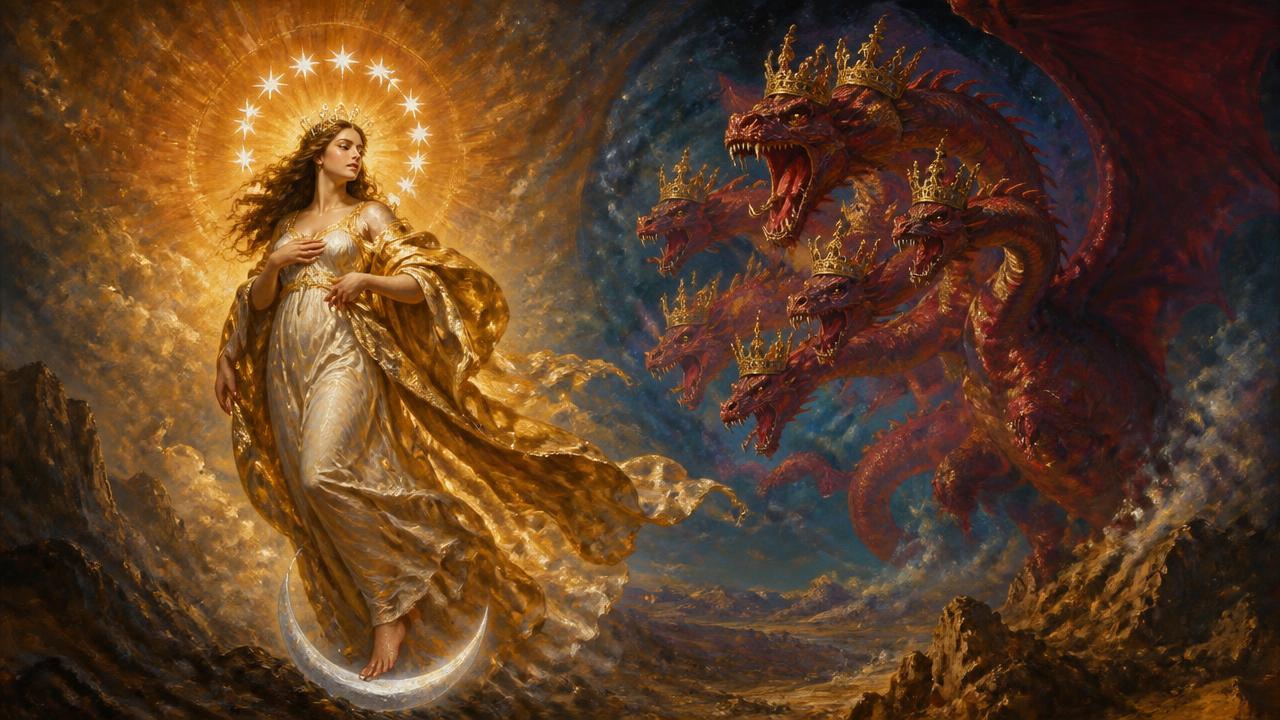
The clothed with the sun — God’s true church (Jer 6:2), wearing the New-Covenant light, the moon (the Old-Covenant types) under her feet, crowned with twelve — travailing to deliver the man child who “was to rule all nations with a rod of iron” (Ps 2:9 — Christ). The great red — Satan (12:9, self-defined), working through pagan Rome — stands before the woman “to devour her child as soon as it was born”: Herod’s swords in Bethlehem. “His tail drew the third part of the stars of heaven” — the original rebellion’s arithmetic, the same third the ’s uprooting of three-of-ten mirrors (Part II §2.7). The child is “caught up unto God, and to his throne” — nativity to ascension in one verse, because this chapter’s interest is the war, not the biography.
War in heaven (12:7–12): “Michael and his angels fought against the ” — the casting down, decisively re-ratified at the cross: “Now is come salvation… for the accuser of our brethren is cast down… they overcame him by the blood of the , and by the word of their testimony” (12:10–11) — the war’s weapons, stated once for every era.
The in the wilderness (12:6, 14): “a thousand two hundred and threescore ”; “a time, and times, and half a time” — the again (538–1798), the true church preserved in hiding (the valleys, the , the new world) while the flood of persecution pours from the serpent’s mouth and “the earth helped the woman” — sparsely-peopled regions (earth vs. , the lexicon) swallowing the flood: the wilderness continents sheltering the exiles. (Note well against Flag 7: this — Revelation 12’s wilderness — is the historical 1260; Revelation 17’s wilderness vision is a different scene with a future vantage.)
The remnant (12:17): “And the was wroth with the , and went to make war with the remnant of her seed, which keep the commandments of God, and have the testimony of Jesus Christ.” After 1798, the dragon’s war narrows to the last of the woman’s line — identified by two marks: all the commandments (the fourth included) and the testimony of Jesus, “the spirit of prophecy” (19:10). The rest of the book is the story of this verse. And the mark-of-the- crisis, in this frame, is a treasure hunt: “The is simply designed to expose who has the treasure” (Apr 2026) — the dragon hunting the remnant Christ treasures.
OT roots. Gen 3:15 (the whole chapter is its exposition — the seed, the serpent, the enmity) · Isa 14:12–15; Eze 28:12–17 (the fall of Lucifer) · Ex 19:4 (eagle’s to the wilderness) · Dan 7:25 (the 1260).
Drawn from the same framework published on The Foundations.
How this chapter is read
The symbol keys and study principles that govern this chapter. Every conclusion is checked against Scripture — follow the references and read them for yourself.
Symbol keys · 7
Woman clothed with the sun
The church clothed in the righteousness of Christ
Basis: Revelation 12:1 and the symbolic representation of righteousness
The dragon
Satan and his attempts to destroy Christ and His followers
Basis: Revelation 12 depicts the dragon's efforts to devour the man-child
Dragon
Satan or a nation opposing God's people
Basis: Revelation 12 depicts the dragon as Satan working through Rome
The wilderness
A place of testing and spiritual significance, often associated with God's people
Basis: Revelation 12 and 17, and the Exodus narrative
Crown of 12 stars
The 12 tribes of Israel or the church as God's people
Basis: The woman in Revelation 12 represents God's people, and the crown signifies authority and completeness
Dragon
Satan and the Roman Empire
Basis: The dragon's characteristics in Revelation 12 align with the Roman Empire's role in Christ's crucifixion and Satan's influence
The dragon
Satan's influence and deception within the church and the world
Basis: Revelation 12:9 describes the dragon as Satan, who deceives the whole world
Study principles · 11
The 1260-day prophecy can be applied to periods of persecution and spiritual trial. This period symbolizes times of testing and endurance for Christ, the church, and individual believers.
Patterns in biblical time prophecies can reveal deeper structures and connections within scripture. Recognizing patterns such as chiastic structures helps to uncover the interconnectedness of biblical events and prophecies.
Time prophecies in the Bible often have both a local and a global application. The 70 weeks prophecy in Daniel 9 has a local application to the Jews and a global application in Revelation.
The relationship between church and state is a recurring theme in biblical narratives, particularly in the context of judgment. This principle emphasizes the importance of recognizing how societal structures influence spiritual conditions and vice versa.
Personal experience and testimony are vital for sharing faith. Sharing personal experiences encourages others and strengthens community.
Satan will attempt to counterfeit Christ's return with overwhelming deception. The Bible warns of a strong delusion where Satan will impersonate Christ.
2 Thessalonians 2:9-11Revelation 12:12The identity of Michael the Archangel can be understood as Jesus when considering the context of direct confrontations with Satan. In every biblical instance where Michael is mentioned, it involves a direct conflict between Jesus and Satan, indicating that Michael is a title for Jesus in these contexts.
Prophetic symbols often represent historical powers or events, and their interpretation requires understanding their scriptural and historical context. The dragon in Revelation 12 is linked to the Roman Empire and Satan, showing how symbols can represent both earthly powers and spiritual forces.
The book of Daniel emphasizes the power of anti-Christian entities, while Revelation provides the counteraction through God's church and the ultimate victory of God's kingdom. Daniel focuses on the rise and actions of anti-God powers, while Revelation reveals the church's role and God's ultimate triumph.
The fulfillment of prophecies often involves both literal and spiritual applications. Events described in Daniel have both historical fulfillments and future spiritual applications, as seen in the roles of pagan and papal Rome.
The concept of the 'wilderness' in prophecy can represent both historical periods of persecution and future times of tribulation. Understanding the wilderness as a symbol helps to interpret periods of trial and testing for God's people.
Rev 12:6Matt 24:15-26
Revelation 12 — the full dossier
The long-form file on this chapter: the history behind it, the earlier Scripture standing under it, its symbols and chain references, where its principle is visible today, and the objections that attach to it. Three registers are kept distinct — documented history, internal biblical parallel, and interpretive correspondence.
The dossier is research-grade and runs 1,500 to 2,500 words. It opens at the Scholarly reading level, alongside the Old Testament roots, the present-day threads and the objections.