
Daniel 9
King James Version · 27 verses · tap a verse for its study panel
Listen to Daniel 9
The full chapter read aloud in a natural voice.
What the verse says and what it means. One reading, no tabs. Saved in this browser.
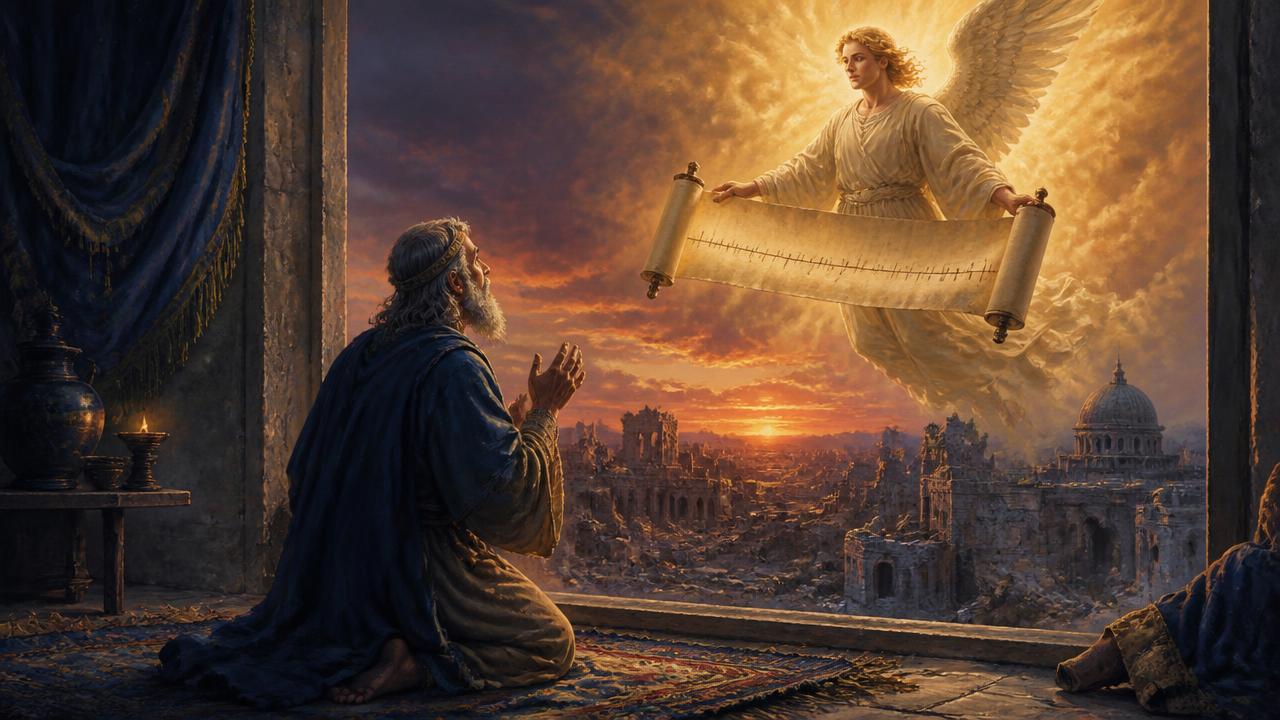
The chapter exposition
Daniel 9 — seen whole
The chapter read as one picture before any verse is opened: what the scene shows, where it sits in the continuous story, and the chain references that hold it to the rest of Scripture.
2.9 Daniel 9 — Seventy Weeks: The Timeline That Lands on Christ
The setting. Darius’s first year, 538 BC. Daniel, reading Jeremiah’s seventy years, prays the Bible’s great intercessory confession — “we have sinned… O Lord, hear; O Lord, forgive” — and while he is “speaking in prayer,” Gabriel, “whom I had seen in the vision at the beginning” (9:21 — the explicit link back to chapter 8), arrives to finish the unexplained part: the time.
The prophecy (9:24–27). “ are determined upon thy people” — literally cut off (chathak) — from what? From the only timeline on the table: the . 490 years, severed from the front of the 2300 for the Jewish people, both periods sharing one starting pistol: “from the going forth of the commandment to restore and to build Jerusalem” (9:25).
The decrees defense (the classroom-grade version, Photo-Theology Jul 27, 2026 — and the version the app’s apologetics should carry, since it faces the strongest objection instead of hiding it). Four royal acts touch Jerusalem: Cyrus, 538 BC ( — the temple); Darius, 520 ( — the temple confirmed); Artaxerxes to Ezra, 457 ( — magistrates and judges, civil restoration); Artaxerxes to Nehemiah, 444/445 (Neh 2 — the walls, under the standing decree). The hard objection: says Cyrus performs “all my pleasure: even saying to Jerusalem, Thou shalt be built.” Doesn’t that make 538 the start — and wreck the arithmetic? The resolution is in the text: Cyrus’s actual decree covers the temple only; adds what no earlier decree has — “set magistrates and judges” — the functioning city, the “restore” of (“I will restore thy judges as at the first”). And speaks of the whole work built “according to the commandment of Cyrus, and Darius, and Artaxerxes king of Persia” — three decrees, one commandment. The counting begins when the commandment is complete: 457 BC. “You cannot begin the counting until all three decrees were in place. And now, when you start at 457 BC, lo and behold… that is a decree that brings you down to the very year of Jesus’s baptism.” With every other start date, “the numbers are off, and they’ve got to find some way to manipulate to make it work. And even in the manipulation, it doesn’t work.”
The arithmetic. - 457 BC + 49 years (7 weeks — the street and wall built “in troublous times”) → 408 BC. - 457 BC + 483 years (69 weeks) → AD 27: “unto the Messiah the Prince.” Messiah = Anointed; Jesus is anointed with the Spirit at His baptism (; ), in “the fifteenth year of Tiberius” — AD 27 — and begins preaching “The time is fulfilled” (). Which time? This one. - “In the midst of the week he shall cause the sacrifice and the oblation to cease” → AD 31, the cross. The veil rips top to bottom (): heaven’s own hand announcing that type has met antitype; every thereafter is a denial. - “He shall confirm the covenant with many for one week” → the seventieth week, AD 27–34, the Messiah confirming — not initiating — the everlasting covenant (see Part V §5.4 on why “confirm” dismantles both the gap and the covenant-abolition reading). - AD 34 — Stephen stoned, the Sanhedrin’s formal rejection sealed, the gospel released to the Gentiles (, 4). end; the 2300 continue alone, 1810 more years, to .
“And for the overspreading of abominations he shall make it desolate” (9:27) — the Roman standards on holy ground, Jerusalem desolate; Jesus cites exactly this (“the , spoken of by Daniel the prophet,” ) as His generation’s flight signal — the prophecy’s near horizon, whose far horizon Part IV §4.4 traces.
Double vision. As Daniel 2’s feet carry both Romes, Daniel 9 carries both horizons: the ’ events under pagan Rome (AD 27–34), and — through the 2300 it is cut from — the terminus under the papal era (Daniel 11 Revisited).
Christ connection. This is the chapter that turns arithmetic into evangelism: the timeline lands on Jesus. It is the strongest single argument in Scripture that He is the Messiah — and the reason (Part V §5.2) the late-daters must break the chapter to save their thesis.
Chain references. Rev 12–14 (ten-words pairing: CROSS → GOSPEL) · ; 7:11–26 · · · –8 · Heb 9:15–17.
Drawn from the same framework published on The Foundations.
How this chapter is read
The symbol keys and study principles that govern this chapter. Every conclusion is checked against Scripture — follow the references and read them for yourself.
Symbol keys · 5
Cross
Christ's sacrifice and the gospel
Basis: Daniel 9's prophecy of the Messiah being cut off
Symbol
The decree to restore and build Jerusalem symbolizes the beginning of a significant prophetic timeline leading to the coming of the Messiah. Basis: Daniel 9:25 outlines the decree as a pivotal moment in the prophetic narrative.
Abomination of desolation
End-time deception and false Christ
Basis: Jesus' reference to Daniel 9 in Matthew 24
Prince of the host
Jesus
Basis: Cross-referencing Daniel 8:11 with Daniel 9:25, 11:22, and 12:1, where the prince is consistently identified with Jesus
Prince
Jesus or Satan, depending on the context and actions described
Basis: The actions attributed to the 'prince' in Daniel 9:27 align with Jesus' ministry, not Satan's
Study principles · 40
The 70-year and 70-week prophecies in Daniel are connected, with the former relating to a rejection of the law and the latter to a rejection of Jesus. These time prophecies illustrate the consequences of Israel's disobedience and the extension of mercy through Christ.
Prophetic timelines often have dual applications, reflecting both historical events and future fulfillments. This principle is based on the recurring patterns in biblical prophecy where initial fulfillments foreshadow greater future events.
Prophecies can be understood through multiple dimensions, each revealing different aspects of their fulfillment. This approach allows for a comprehensive understanding of prophecy, showing its application to Christ, the individual believer, the church, and eschatological events.
Time prophecies in the Bible are connected to major divine movements, serving as markers for God's actions. Each significant event in biblical history is associated with a specific time prophecy, indicating divine intervention.
Each chapter of a biblical book can be viewed through multiple dimensions to uncover different layers of meaning. This approach allows for a deeper understanding of the text by considering its implications on various levels, such as personal, church, and cosmic.
The 70-week prophecy in Daniel is tied to the theme of forgiveness and restoration. The 70 times 7 concept reflects God's willingness to forgive and restore His people if they repent.
Daniel 9:24Matthew 18:21-22Summarize complex prophetic chapters with a single word to capture the essence of the chapter. This helps in remembering and understanding the overarching themes and connections between different parts of the prophecy.
Recognize the attack on key elements of faith (truth, sanctuary, Christ, etc.) as a recurring theme in prophecy. Understanding these attacks helps to see the broader narrative of the great controversy.
Time prophecies in the Bible often have both a local and a global application. The 70 weeks prophecy in Daniel 9 has a local application to the Jews and a global application in Revelation.
The 70-week prophecy serves as the starting point for understanding the larger 2300-day prophecy. The 70 weeks are part of the 2300 days, providing a timeline from the decree to rebuild Jerusalem to the coming of the Messiah.
Prophecies in Daniel are repeated and expanded upon in subsequent chapters. Each chapter in Daniel builds upon the previous ones, adding more detail to the prophetic narrative.
The 70 weeks prophecy serves as a timeline for God's plan of redemption and the coming of the Messiah. It highlights the period allotted for the Jewish people to accept their Savior and the consequences of their rejection.
The starting point for prophetic time periods can often be found in related passages. Connecting different prophetic texts can reveal the beginning of a time prophecy.
Understanding the timeline of prophetic events is crucial for interpreting their significance. The connection between the 70 weeks and the 2300 days provides a framework for understanding the fulfillment of prophecy.
The relationship between different time prophecies can enhance understanding of their meanings. Recognizing how prophecies interconnect helps to grasp the broader narrative of Scripture.
The 'repeat and enlarge' principle in prophecy means that subsequent visions build upon previous ones, adding more detail without changing the foundational message. This principle helps to understand the structure of the book of Daniel, where each chapter provides more detail about the prophetic timeline first introduced in Daniel 2.
The cleansing of the sanctuary represents the restoration of truth and the rebuilding of spiritual understanding that was defiled by Babylon. This is paralleled by the historical decree to rebuild Jerusalem after its destruction by Babylon, symbolizing a spiritual restoration in the end times.
The visions in the book of Daniel span thousands of years and culminate with global events, not local ones. Each vision in Daniel ends with events that involve the entire world, such as the second coming of Christ, rather than local historical events.
The prophetic chapters of Daniel are interconnected and deal with the same historical powers. Daniel 2, 7, 8, 9, and 11 all reference the same sequence of kingdoms, showing a unified prophetic narrative.
Prophecies in the book of Daniel are on a global scale, unlike other prophets whose prophecies were more localized. Daniel's visions consistently extend to the end of time, indicating a broader scope.
The visions in Daniel highlight attacks on key aspects of God's kingdom, while the visions in Revelation provide God's responses to these attacks. This principle is based on the thematic parallels between the books of Daniel and Revelation, where each vision in Daniel is countered by a corresponding vision in Revelation.
The beginning and end of a prophecy often mirror each other in thematic elements. The 2300-day prophecy begins and ends with themes of law, judgment, and a remnant.
Prophecies can have both a local and a global application. Daniel 9's prophecy about Jerusalem's destruction also foreshadows end-time events.
The destruction of the temple and city signifies the end of the sacrificial system and associated laws, but not the moral law or the Sabbath. The sacrificial system was directly tied to the temple, whereas the Sabbath and moral law were not dependent on the temple's existence.
Rejecting the prophecies concerning Christ leads to a misunderstanding of His mission and the plan of salvation. The Jews' rejection of Christ was due to their rejection of the prophecies concerning Him, which were illustrated in the sanctuary services.
Use the principle of 'repeat and enlarge' to understand prophetic chapters. Each chapter in Daniel builds on the previous ones, providing more detail.
The little horn of Daniel 8 cannot be Antiochus Epiphanes because it stands against the prince of the host, identified as Jesus. Antiochus Epiphanes lived 150 years before Jesus and could not have opposed Him.
Israel has only one supernatural prince, which is Jesus. The biblical text consistently refers to a singular prince for Israel, and this prince is identified as Jesus, not multiple supernatural beings.
Ezek 37:25Dan 9:25The principle of 'repeat and enlarge' is used to understand prophetic sequences in Daniel and Revelation. This principle helps identify how each vision builds upon the previous one, adding more detail.
Prophetic timelines such as the 70 weeks, 1260 days, and 2300 days provide a framework for understanding historical and future events. These timelines anchor the prophetic narratives in specific historical contexts.
Avoid inserting gaps in prophetic timelines unless explicitly indicated by scripture. Inserting gaps can lead to misinterpretations and distort the intended prophetic message.
Identify the subject of a prophecy by examining the actions attributed to them and cross-referencing with other biblical texts. This helps to accurately determine the identity of figures in prophecy, such as distinguishing between Christ and Satan.
Prophecies in the book of Daniel are interconnected and should be understood as part of a continuous narrative. The prophecies in Daniel 2, 7, 8, and 9 all feature the same sequence of kingdoms and events, suggesting a 'repeat and enlarge' pattern.
The 70-week prophecy in Daniel 9 is a segment of the larger 2300-day prophecy in Daniel 8. The term 'determined' in Daniel 9:24 implies a portion being cut off from a larger whole, linking it to the 2300 days.
Understanding the 'why' behind a prophecy enhances comprehension and retention. Knowing the reasons behind the prophecy allows for deeper reflection and connection-making.
The principle of 'repeat and enlarge' is used throughout the book of Daniel, where each subsequent vision builds on the previous ones with more detail. This principle helps in understanding the continuity and expansion of prophetic events across the chapters.
Transition points in prophetic chapters indicate shifts in historical powers or significant events. Identifying these points helps to map the progression of prophecy and align it with historical events.
In biblical prophecy, particularly in Daniel and Revelation, time periods should be interpreted using the day-for-a-year principle. The angel in Daniel 9 uses a day-for-a-year principle to explain the 70 weeks prophecy, which is part of the same overarching prophecy that includes other time periods like the 1260 and 2300 days.
The historical context of prophetic writings is crucial for accurate interpretation. Recognizing the cultural and societal issues of the time can illuminate the meaning of the text.
The concept of mercy is foundational to God's character and is extended to both angels and humanity. God's patience with Lucifer and His offer of mercy to humanity illustrate His desire for reconciliation.
Matt 18:21-22Dan 9:24
Daniel 9 — the full dossier
The long-form file on this chapter: the history behind it, the earlier Scripture standing under it, its symbols and chain references, where its principle is visible today, and the objections that attach to it. Three registers are kept distinct — documented history, internal biblical parallel, and interpretive correspondence.
The dossier is research-grade and runs 1,500 to 2,500 words. It opens at the Scholarly reading level, alongside the Old Testament roots, the present-day threads and the objections.