
Daniel 6
King James Version · 28 verses · tap a verse for its study panel
Listen to Daniel 6
The full chapter read aloud in a natural voice.
What the verse says and what it means. One reading, no tabs. Saved in this browser.
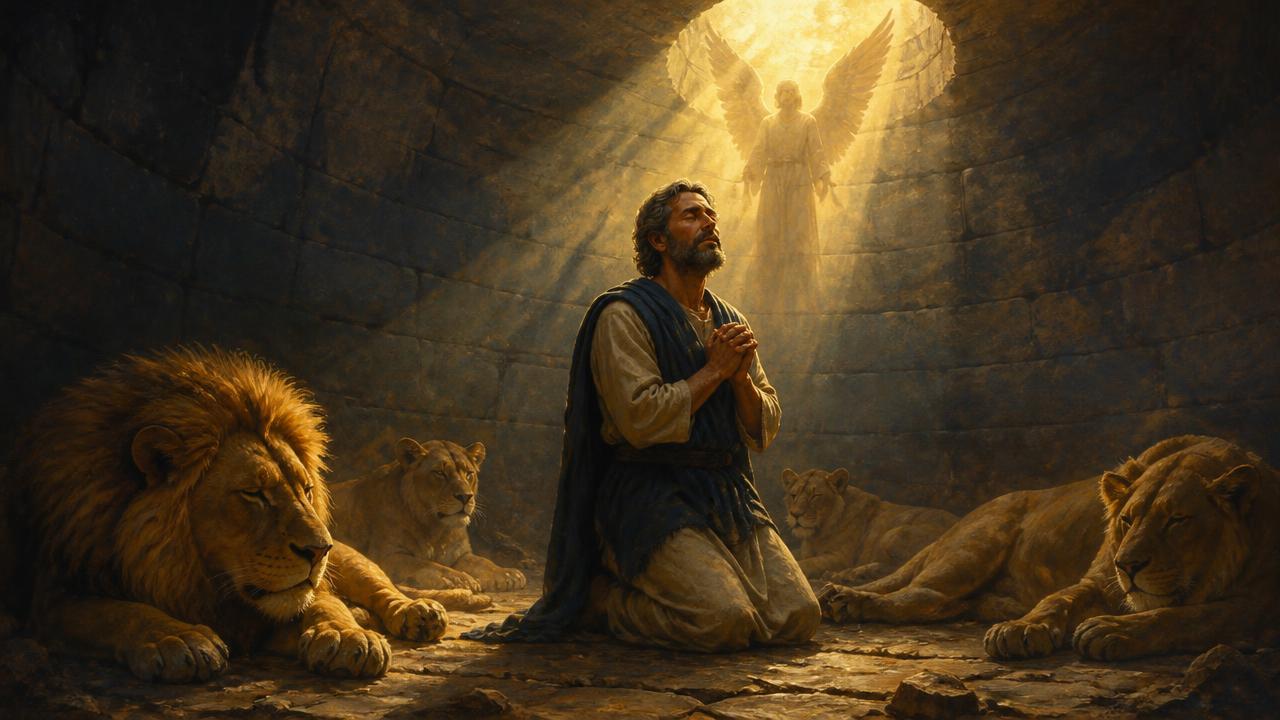
The chapter exposition
Daniel 6 — seen whole
The chapter read as one picture before any verse is opened: what the scene shows, where it sits in the continuous story, and the chain references that hold it to the rest of Scripture.
2.6 Daniel 6 — The Lions’ Den: The Death Decree Against Prayer
The history. Darius organizes the new empire; Daniel, now in his eighties, distinguishes himself “because an excellent spirit was in him”; jealous colleagues, finding “no error or fault” in him, engineer the only accusation that can stick: “We shall not find any occasion against this Daniel, except we find it against him concerning the law of his God” (6:5). A thirty- decree — pray to no god or man but the king — signed under Medo-Persian law that “altereth not.” Daniel, “when he knew that the writing was signed,” goes home, opens his windows toward Jerusalem, “and prayed… as he did aforetime” (6:10).
The exposition. Daniel 6 is the second narrative panel of the end-time crisis, and it complements Daniel 3 exactly. In Daniel 3 the state commands false worship; in Daniel 6 the state criminalizes true worship. The last conflict has both faces: the image-worship commanded (Rev 13:15) and the commandments of God criminalized (Rev 13:16–17 — no buying, no selling, then the death decree; cf. Rev 12:17, the ’s wrath against “them which keep the commandments of God”). The trap is procedurally perfect, legally unbreakable, and aimed at a man whose only “fault” is fidelity — precisely the accused remnant’s situation.
Daniel’s response is studied calm: no protest, no hiding, no performance — “as he did aforetime.” The saints do not begin faithfulness at the crisis; the crisis reveals the faithfulness that habit built. Darius’s sleepless night, the dawn cry, the -sealed den from which God’s servant emerges alive, the accusers destroyed by their own device, the pagan king’s decree that all men fear Daniel’s God — every beat replays in the deliverance of Daniel 12:1 and Revelation’s vindication scenes. And the sealed over a den that could not hold God’s faithful one whispers a greater morning.
Chain references. Rev 13:15–17 · Rev 12:17 · Ps 91:11–13 · Heb 11:33 · :6.
Drawn from the same framework published on The Foundations.
How this chapter is read
The symbol keys and study principles that govern this chapter. Every conclusion is checked against Scripture — follow the references and read them for yourself.
Study principles · 1
Each chapter of a biblical book can be viewed through multiple dimensions to uncover different layers of meaning. This approach allows for a deeper understanding of the text by considering its implications on various levels, such as personal, church, and cosmic.
Daniel 6 — the full dossier
The long-form file on this chapter: the history behind it, the earlier Scripture standing under it, its symbols and chain references, where its principle is visible today, and the objections that attach to it. Three registers are kept distinct — documented history, internal biblical parallel, and interpretive correspondence.
The dossier is research-grade and runs 1,500 to 2,500 words. It opens at the Scholarly reading level, alongside the Old Testament roots, the present-day threads and the objections.