
Daniel 11
King James Version · 45 verses · tap a verse for its study panel
Listen to Daniel 11
The full chapter read aloud in a natural voice.
What the verse says and what it means. One reading, no tabs. Saved in this browser.
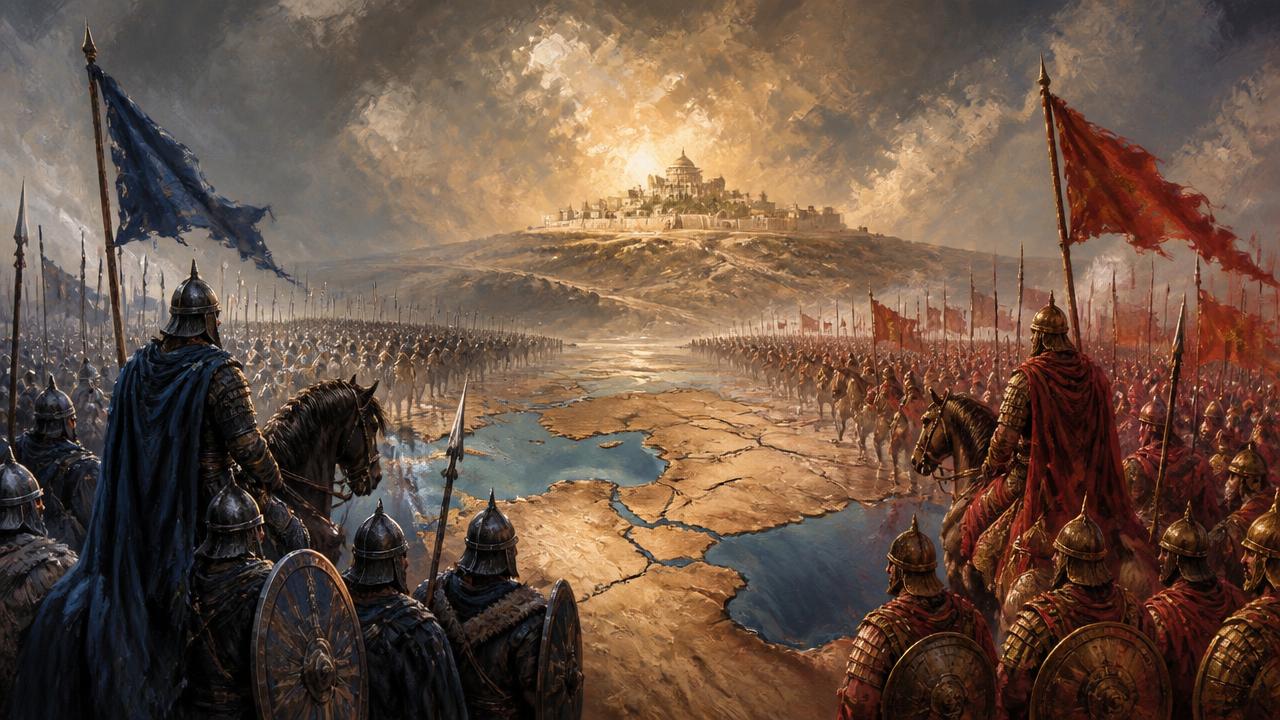
The chapter exposition
Daniel 11 — seen whole
The chapter read as one picture before any verse is opened: what the scene shows, where it sits in the continuous story, and the chain references that hold it to the rest of Scripture.
2.11 Daniel 11 — The Long War of North and South
The book’s most demanding chapter, and the corpus’s signature scholarship. The structural key (Daniel 11 Revisited): vv. 1–22 walk the era the measure; vv. 23–39 walk the era the 1260 measures; vv. 40–45 walk the end, in the territory of the 2300’s terminus. ⚑ The reading below departs from Uriah Smith at vv. 23–39 and 36–37 — deliberately, on EGW’s placement of the papacy at v. 30 (13MR 394.1); see Flag 5. And it follows the current, stated whole-chapter conviction (Aug 24, 2026): “The meat is in the entire chapter.”
vv. 1–4 — From Persia to the shattered empire. Three more Persian kings, then a rich fourth (Xerxes) who “shall stir up all against the realm of Grecia” — provoking the vengeance that eventually marches back under “a mighty king” (v. 3, Alexander), whose kingdom is “divided toward the four … and not to his posterity” (v. 4) — the four of Daniel 8, exactly.
vv. 5–15 — Literal kings of the South and North. Here the titles are born: after the division, from Judea’s vantage the king of the south is the Ptolemaic dynasty (Egypt) and the king of the north the Seleucid (Syria). The verses track the real chronicle — the marriage-alliance of Berenice and Antiochus II and its murders (v. 6), her avenger Ptolemy III’s counter-campaign (vv. 7–9), the seesaw wars, Antiochus III “the Great” overwhelming the south (vv. 10–15) — “this is in the Grecian Empire, so this is before Rome even comes on the scene… It’s just showing how meticulously God leads up to the introduction to the ” (Aug 24, 2026). Antiochus Epiphanes’ dynasty is genuinely here, in vv. 5–15 — which is precisely why he is not the little horn: the book gives him his real, minor place. ⚑ Flag 11c: state the double role together.
vv. 16–22 — Rome enters and the Messiah is cut off. “He that cometh against him shall do according to his own will, and none shall stand before him: and he shall stand in the glorious land” (v. 16) — Rome, irresistible, planted in Judea (63 BC). The “raiser of taxes” (v. 20) — Augustus, whose census walks Joseph and Mary to Bethlehem (). Then “a vile person” obtaining the kingdom by flatteries (v. 21) — Tiberius; and under him, the verse the whole chapter has been building toward: “and the prince of the covenant” shall be broken (v. 22) — Messiah cut off, AD 31, under the arms of Rome. The 70-weeks era section closes on the cross. Watch the discovery logged Aug 24, 2026: the vv. 13–15 sequence — the south pushes, the north returns overwhelming, Rome stands in the glorious land — was recognized (and confirmed through the app’s own study engine) as a structural preview of Revelation 13’s wound-and-healing arc: the pattern of powers striking and returning is the chapter’s grammar, stated early so the reader recognizes it at v. 40.
vv. 23–30 — The league, and papal Rome’s rise. “After the league made with him he shall work deceitfully: for he shall come up, and shall become strong with a small people” (v. 23). Here this teaching breaks with Uriah Smith, who kept pagan Rome through v. 30 (dating the league to Rome’s Jewish alliance, 161 BC): the league is Constantine’s fusion of church and empire (AD 321 forward) — and from it rises a power “small” at first that grows “strong,” working deceitfully, prospering by peace where armies failed: the papacy. Ellen White places the papacy at v. 30 (“Much of the history that has taken place in fulfillment of this prophecy will be repeated,” 13MR 394.1), and the manuscript follows her rather than Smith — self-labeled, with scholarly honesty, “not as a dogmatic position of truth, but only as a possible solution.” The “ships of Chittim” and the returning intelligence “with them that forsake the holy covenant” (v. 30) land in the era of Islam’s naval pressure and the Counter-Reformation’s councils.
vv. 31–39 — The 1260 in royal chronicle. “Arms shall stand on his part, and they shall pollute the of strength, and shall take away the daily, and they shall place the ” (v. 31) — the same career Daniel 7:25 and 8:11–12 described, now in prose: the interposed priesthood, the trampled truth, the persecuted faithful — “they that understand among the people shall instruct many: yet they shall fall, by the sword, and by flame, by captivity, and by spoil, many ” (v. 33; the Waldenses, the Reformers, the martyrs) — “and some of them of understanding shall fall, to try them, and to purge, and to make them white, even to the time of the end” (v. 35): persecution’s refining purpose, running to 1798. vv. 36–39: the willful king exalting himself above every god, honoring “a god whom his fathers knew not” with gold and precious stones — kept here as the papacy still (⚑ against Smith’s France reading; Flag 5), the description matching Revelation 17:4’s gold-decked .
vv. 40–45 — The Time of the End: the signature exposition. “And at the time of the end” — 1798 — “shall the king of the south push at him.”
The king of the south at the time of the end = atheism/militant secularism, born in the French Revolution — the power that “pushed” in 1798 by wounding the papacy (Berthier’s entry into Rome). Why “south”? Egypt’s Pharaoh spoke its creed first: “Who is the LORD, that I should obey his voice? I know not the LORD” (Ex 5:2) — open defiance of God, “open evil against Christianity, while the KON represents evil disguised under Christianity.” During the 1260 the south’s banner was carried by Islam (the Rev 9 woes; the Ottoman pressure); at the time of the end the banner passes to the Revolution’s stream — atheism, secularism, communism. ⚑ Two-layer teaching, deliberately; see Flag 6.
The king of the north = the papacy — and behind it, finally, Satan himself. The true King of the North is God (“the sides of the north,” Ps 48:2; Isa 14:13 — the throne Lucifer coveted). The papacy holds the counterfeit claim through history; but “the king of the north, the papacy, is a shadow form of the final actions of the last and final king of the north, Satan himself… might the Papacy be to Satan what John the Baptist was to Jesus?” (Daniel 11 Revisited). The double vision of the whole book (two Romes in the feet, two horizons in the ) resolves here into its last form: an institution, and then the being behind it, stepping on stage in person.
The whirlwind counterattack (v. 40b) — “the king of the north shall come against him like a whirlwind, with chariots, and with horsemen, and with many ships; and he shall enter into the countries, and shall overflow and pass over.” What could overwhelm entrenched global secularism? “Only one event could overwhelm atheism, secularism, communism, lawlessness, radical Islam… the overmastering delusion of Satan appearing as Christ” (GC 624’s “crowning act,” quoted at length in the manuscript). The chariots, horsemen, and many ships are Satan’s forces — his “air force and navy” (Back to Basics V): the armies of this campaign are demonic, its conquests are conversions. supplies the pedigree: Nebuchadnezzar, “king of , a king of kings, from the north, with horses, and with chariots” — the whirlwind-from-the-north is Babylon’s own signature, now worn by Babylon’s final king.
Geography spiritualized (vv. 41–43). After v. 23 the map is symbolic: “America is symbolic of Protestantism worldwide, France of Atheism worldwide, Rome of the Papacy’s worldwide influence, and Jerusalem of God’s people worldwide” (Daniel 11 Revisited). He “enters into the glorious land” — the professed church; “many countries shall be overthrown” — mass capitulation; “but these shall escape… Edom, and Moab, and the chief of the children of Ammon” — the unlikely outsiders who escape the deception, as those nations lay outside Israel yet sheltered David’s line. “Egypt shall not escape” — secularism itself converts under the miracles; “the Libyans and the Ethiopians shall be at his steps” — the whole non-Christian world falls in line. The three unclean spirits of Revelation 16:13–14 are this same global gathering, camera two.
“Tidings out of the east and out of the north shall trouble him” (v. 44) — from the directions of God’s own approach (the east, ; the north, Ps 48:2): the loud cry of Revelation 18, the announcement of the true King’s coming, troubles the counterfeit; “he shall go forth with great fury to destroy” — the death decree of the final crisis.
“He shall plant the tabernacles of his palace between the in the glorious holy ” (v. 45) — planting = founding a kingdom (Isa 5:1–7; Jer 24:6); tabernacle (worship) + palace (state): the completed counterfeit — a worldwide church-state kingdom, seated “between the seas” (among the peoples, Rev 17:15) and against “the glorious holy mountain,” God’s people. It is the image of Daniel 3 rebuilt at planetary scale, the abomination in its final desolating form.
“Yet he shall come to his end, and none shall help him” — no rescue, no eighth act. The verse division into chapter 12 is artificial; the sentence completes in Daniel 12:1: “And at that time shall Michael stand up.”
Chain references. Rev 15–22 (ten-words pairing: the RESCUE) · Rev 16:12–16 (the gathering; the Euphrates) · Rev 17–18 (the and her fall) · GC 624 · Ex 5:2 · Eze 26:7 · Ps 48:1–2.
Drawn from the same framework published on The Foundations.
How this chapter is read
The symbol keys and study principles that govern this chapter. Every conclusion is checked against Scripture — follow the references and read them for yourself.
Symbol keys · 5
Northern army
Rome
Basis: The identification of Rome as the king of the north in Daniel 11
King
Christ as the ultimate ruler
Basis: Daniel 11's conflict culminating in the true King of the North
King of the North
Initially Rome, then the papacy, and ultimately a representation of Satan
Basis: The progression of powers in Daniel 11 and the broader biblical narrative
King of the North
Rome and later Papal Rome
Basis: Represents the dominant power opposing God's people in Daniel 11
Whirlwind
A swift and overwhelming force, often representing divine intervention or judgment
Basis: In Daniel 11:40, the king of the north's return like a whirlwind signifies a powerful and decisive action
Study principles · 21
Each chapter of a biblical book can be viewed through multiple dimensions to uncover different layers of meaning. This approach allows for a deeper understanding of the text by considering its implications on various levels, such as personal, church, and cosmic.
Summarize complex prophetic chapters with a single word to capture the essence of the chapter. This helps in remembering and understanding the overarching themes and connections between different parts of the prophecy.
Recognize the attack on key elements of faith (truth, sanctuary, Christ, etc.) as a recurring theme in prophecy. Understanding these attacks helps to see the broader narrative of the great controversy.
Prophecies in Daniel are repeated and expanded upon in subsequent chapters. Each chapter in Daniel builds upon the previous ones, adding more detail to the prophetic narrative.
Religious symbols can mask political ambitions in prophetic narratives. The use of religious imagery in prophecy often disguises underlying political motives.
The pattern of 'repeat and enlarge' is essential for understanding the structure and prophecies of the book of Daniel. This pattern reveals how each chapter builds upon the previous one, providing more detail and insight into the prophetic timeline.
Understanding the big picture of a biblical book helps in interpreting individual passages within their broader context. A comprehensive view allows for better understanding of specific details and their significance within the whole narrative.
The prophetic chapters of Daniel are interconnected and deal with the same historical powers. Daniel 2, 7, 8, 9, and 11 all reference the same sequence of kingdoms, showing a unified prophetic narrative.
The visions in Daniel highlight attacks on key aspects of God's kingdom, while the visions in Revelation provide God's responses to these attacks. This principle is based on the thematic parallels between the books of Daniel and Revelation, where each vision in Daniel is countered by a corresponding vision in Revelation.
Use the principle of 'repeat and enlarge' to understand prophetic chapters. Each chapter in Daniel builds on the previous ones, providing more detail.
Understand that prophetic symbols can shift focus over time. The emphasis in Daniel shifts from Rome to the papacy and ultimately to the final Antichrist.
Consider the historical context to identify the 'king of the north' and 'king of the south'. These terms have shifted from literal geographic powers to symbolic representations of spiritual forces.
Understand the broader context of a passage to avoid getting lost in details. Knowing the general surroundings helps in interpreting specific verses.
Prophetic symbols often have historical and future applications. Events in biblical history can foreshadow future spiritual realities.
Daniel 11Ezekiel 26:7The little horn of Daniel 8 cannot be Antiochus Epiphanes because it stands against the prince of the host, identified as Jesus. Antiochus Epiphanes lived 150 years before Jesus and could not have opposed Him.
The destruction of the little horn is described as occurring without human hand, indicating divine intervention. This aligns with the destruction of powers in Daniel 2 and 7, which are also described as being destroyed by divine means.
The principle of 'repeat and enlarge' is used to understand prophetic sequences in Daniel and Revelation. This principle helps identify how each vision builds upon the previous one, adding more detail.
Identifying transition points between world powers in prophetic texts helps clarify the timeline and sequence of events. Recognizing these transitions allows for a clearer understanding of the historical and prophetic flow.
The principle of 'repeat and enlarge' is used throughout the book of Daniel, where each subsequent vision builds on the previous ones with more detail. This principle helps in understanding the continuity and expansion of prophetic events across the chapters.
Transition points in prophetic chapters indicate shifts in historical powers or significant events. Identifying these points helps to map the progression of prophecy and align it with historical events.
Prophetic symbols often have dual applications, representing both historical and future events. This principle helps to understand how prophecies can be fulfilled in multiple phases, such as the historical persecution of the church and future end-time events.
Daniel 11 — the full dossier
The long-form file on this chapter: the history behind it, the earlier Scripture standing under it, its symbols and chain references, where its principle is visible today, and the objections that attach to it. Three registers are kept distinct — documented history, internal biblical parallel, and interpretive correspondence.
The dossier is research-grade and runs 1,500 to 2,500 words. It opens at the Scholarly reading level, alongside the Old Testament roots, the present-day threads and the objections.