
Revelation 1
King James Version · 20 verses · tap a verse for its study panel
Listen to Revelation 1
The full chapter read aloud in a natural voice.
What the verse says and what it means. One reading, no tabs. Saved in this browser.
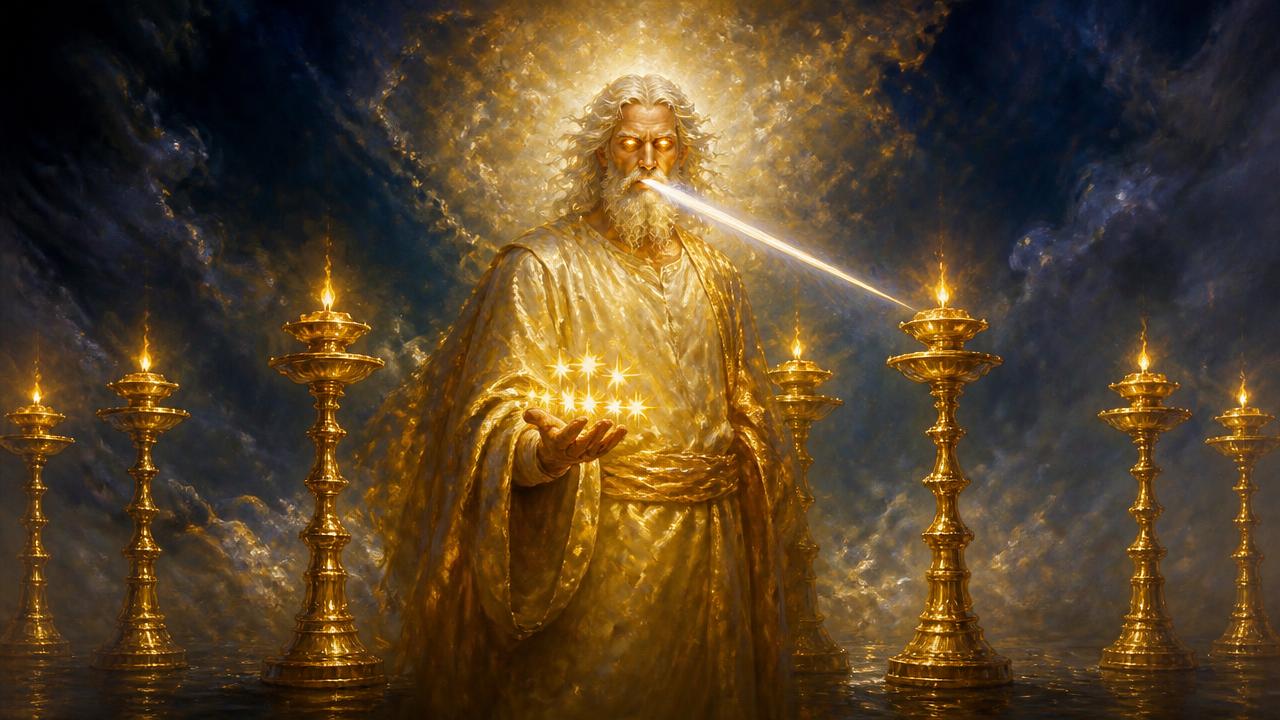
The chapter exposition
Revelation 1 — seen whole
The chapter read as one picture before any verse is opened: what the scene shows, where it sits in the continuous story, and the chain references that hold it to the rest of Scripture.
3.1 Revelation 1 — The One Among the Candlesticks
John, “in the isle that is called Patmos, for the word of God” (1:9), is “in the Spirit on the Lord’s ” and hears the -voice. He turns — and the first thing Revelation shows is not a , a plague, or a timeline: it is Jesus, “one like unto the Son of man” (Daniel 7’s title, deliberately), walking among seven golden candlesticks, girt with gold, eyes as fire, feet as fine brass, His countenance as the sun — the very Man of Daniel 10:5–6, now bearing the marks of triumph: “I am he that liveth, and was dead; and, behold, I am alive for evermore, Amen; and have the keys of hell and of death” (1:18).
The candlesticks are the churches (1:20 — the book defining its own symbols, immediately). The message before all messages: whatever the next twenty-one chapters contain, He is in the midst of the candlesticks — present in His church through every age the prophecy will now traverse. “The seven ” — the angels/messengers of the churches — are “in his right hand”: the church’s leaders held, not holding.
OT roots. Dan 7:9, 13; 10:5–6 · Ex 25:31–37 (the candlestick) · (the lampstand and the two olive trees) · Isa 44:6 (“the first and the last”).
Drawn from the same framework published on The Foundations.
How this chapter is read
The symbol keys and study principles that govern this chapter. Every conclusion is checked against Scripture — follow the references and read them for yourself.
Symbol keys · 6
Seven candlesticks
The seven churches
Basis: Revelation 1:20
Candlestick
The church as the light of the world
Basis: Revelation 1-3's depiction of the seven churches
Seven candlesticks in Revelation
The works of God's church
Basis: Revelation 1-3 describes Jesus among the candlesticks, symbolizing the church's role as a light to the world
Candlesticks
The presence of Christ among His churches
Basis: Revelation 1:20 describes the candlesticks as the churches
Seven branch candlestick
The seven churches
Basis: Revelation 1:12-13 shows Jesus standing among the candlesticks, representing the churches
Seven golden candlesticks
The seven churches
Basis: Revelation 1:20 identifies the candlesticks as the seven churches
Study principles · 15
The seven churches, seals, and trumpets in Revelation unfold simultaneously within the holy place of the sanctuary. The priests ministered simultaneously at the candlestick, table of showbread, and altar of incense in the holy place.
The numbers one through seven in Revelation represent a complete cycle of time. The sequence of seven indicates a full and complete period, as seen in the seven churches, seals, and trumpets.
Understanding the entire Bible is crucial for interpreting the books of Daniel and Revelation correctly. These books are deeply interconnected with the rest of Scripture, requiring comprehensive biblical knowledge to avoid misinterpretation.
The book of Revelation is structured around the sanctuary, with its cycles of seven representing complete cycles of time. The sanctuary pattern in Revelation helps to understand the progression and simultaneous unfolding of events.
The cycles of seven in Revelation (churches, seals, trumpets) unfold simultaneously and share the same starting and ending points. This reflects the simultaneous ministry of the priest in the holy place, indicating that these cycles are interconnected.
The seven churches, seals, and trumpets in Revelation represent a complete cycle of time from Pentecost to the end of the world and should be interpreted as parallel to each other. This parallelism is based on the structure and patterns found in the sanctuary and feast days, which align with the historical and prophetic timeline.
Prophecies in Daniel and Revelation should be studied in parallel to understand the full picture of God's plan. Both books contain complementary visions that reveal the rise and fall of earthly kingdoms and the establishment of God's eternal kingdom.
Prophecies in Daniel and Revelation are interconnected, with events in Daniel serving as a microcosm of larger, end-time events in Revelation. The visions in Daniel and Revelation parallel each other, providing a complete storyline of prophetic events.
Understanding the overarching themes of biblical prophecy can provide clarity before delving into specific details. By grasping the big picture, students can better navigate the complexities of prophetic texts without getting lost in the details.
Patterns in prophecy reveal the harmonious relationship between Daniel and Revelation. Understanding these patterns shows the interconnectedness of biblical prophecies and their fulfillment.
The seven churches, seals, and trumpets in Revelation unfold simultaneously within the context of the holy place. The priest in the Old Testament ministered at all articles of furniture in the holy place simultaneously, indicating a parallel unfolding.
Prophetic visions in Daniel and Revelation are interconnected and should be studied together to understand the full scope of the cosmic conflict. Daniel and Revelation are sister books, with each vision in Daniel having a corresponding vision in Revelation that expands and answers it.
The sanctuary articles and their functions can be used to interpret the sequence and themes of biblical books. The sanctuary articles represent different aspects of the Christian experience and God's plan, which are mirrored in the structure of biblical narratives.
Exodus 26:35Revelation 1:12-20The seven churches, seals, and trumpets in Revelation represent cycles of time with a beginning and an ending point. This cyclical pattern reflects the progression of church history from Pentecost to the second coming of Christ.
Prophetic books often have complementary sections that provide a fuller understanding when studied together. The book of Revelation is seen as an answer to the book of Daniel, with its sections paralleling and expanding on the themes introduced in Daniel.
Revelation 1 — the full dossier
The long-form file on this chapter: the history behind it, the earlier Scripture standing under it, its symbols and chain references, where its principle is visible today, and the objections that attach to it. Three registers are kept distinct — documented history, internal biblical parallel, and interpretive correspondence.
The dossier is research-grade and runs 1,500 to 2,500 words. It opens at the Scholarly reading level, alongside the Old Testament roots, the present-day threads and the objections.