
Daniel 2
King James Version · 49 verses · tap a verse for its study panel
Listen to Daniel 2
The full chapter read aloud in a natural voice.
What the verse says and what it means. One reading, no tabs. Saved in this browser.
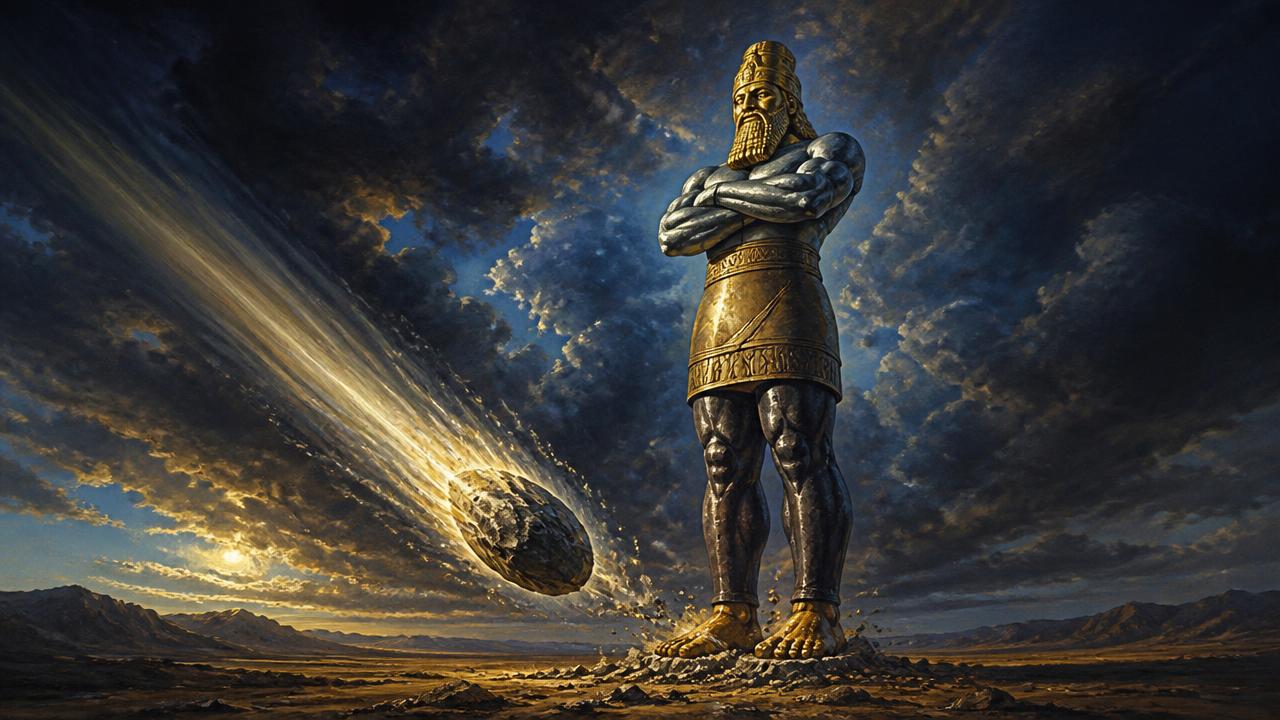
The chapter exposition
Daniel 2 — seen whole
The chapter read as one picture before any verse is opened: what the scene shows, where it sits in the continuous story, and the chain references that hold it to the rest of Scripture.
2.2 Daniel 2 — The Trailer: One Statue, All of History
The history. ~603 BC. Nebuchadnezzar dreams, forgets, and demands the impossible: tell me the dream and its meaning. The wise men fail; the death decree goes out; Daniel requests time, prays with his three friends, and receives “the secret… in a night vision” (2:19). Before the king, he deflects all credit: “There is a God in heaven that revealeth secrets” (2:28).
The image. A great statue: head of gold, breast and arms of silver, belly and thighs of brass, legs of iron, feet of iron mingled with miry clay — struck on the feet by a cut out without hands, ground to chaff, and the stone becomes a filling the whole earth.
The interpretation — the Bible’s own. - Gold = (605–539 BC): “Thou art this head of gold” (2:38). The lion’s kingdom, the golden city (Isa 14:4; Jer 51:7). - Silver = Medo-Persia (539–331 BC): “after thee shall arise another kingdom inferior to thee” (2:39) — named in 8:20. - Brass = Greece (331–168 BC): “a third kingdom of brass, which shall bear rule over all the earth” — named in 8:21; Alexander’s bronze-armored phalanx. - Iron = Rome (168 BC–AD 476): “strong as iron: forasmuch as iron breaketh in pieces and subdueth all things” (2:40) — the iron monarchy that crucified the Lord and ground the world. - Iron and clay = divided Europe (AD 476 →): the ten toes; “they shall mingle themselves with the seed of men: but they shall not cleave one to another” (2:43). Every Charlemagne, every Charles V, every Napoleon, every Kaiser, every führer who tried to weld the toes back into a leg has broken against one sentence of this prophecy.
The double vision of the feet. The mingling of iron and clay is not merely political fragmentation. Clay, in the prophets, is what the Potter shapes — the covenant people, the church (Isa 64:8; Jer 18:1–6). Iron is the state. “The mingling of churchcraft and statecraft is represented by the iron and the clay” (EGW, 4BC 1168.8, cited in Daniel 11 Revisited). The feet are therefore a preview of the ’s whole career: church fused with state, strength fused with weakness, Rome surviving its own fall in a new, mingled form. Daniel 2 already contains Daniel 7 — the student just doesn’t know it yet. That is how teaches.
The . “In the of these kings shall the God of heaven set up a kingdom, which shall never be destroyed… it shall break in pieces and consume all these kingdoms, and it shall stand for ever” (2:44). The stone is cut “without hands” — no human politics assembles God’s kingdom; the stone strikes the feet — the kingdom arrives in the days of divided Europe, not before; and the stone becomes a — the kingdom replaces, it does not reform, the world’s empires. The identical claim ends every vision in the book. The app’s guided journey presents this chapter as the trailer for the whole prophetic storyline, because that is what it is: every later vision is this sequence re-shot at higher resolution.
Christ connection. The the builders refused (Ps 118:22; ): “whosoever shall fall on this shall be broken: but on whomsoever it shall fall, it will grind him to powder” — Jesus quoting Daniel 2 about Himself.
Chain references. Rev 1–3 (the ten-words pairing: the same history from the churches’ side) · Dan 7 (same sequence in ) · Rev 17:12–14 (the ten ’ final hour) · .
Drawn from the same framework published on The Foundations.
How this chapter is read
The symbol keys and study principles that govern this chapter. Every conclusion is checked against Scripture — follow the references and read them for yourself.
Symbol keys · 22
Mountain cast into the sea
The fall of pagan Rome
Basis: Revelation 8:8, Daniel 2:34-35
The image of a man in Nebuchadnezzar's dream
different kingdoms
Basis: Daniel 2 describes the image as symbolizing successive world empires
The image of a man in Daniel 2
the kingdoms of the world and the individual who rejects Christ
Basis: The progression of metals from gold to iron symbolizes increasing hardness and resistance to God's kingdom
Iron and clay
The mingling of incompatible elements, representing spiritual compromise or apostasy
Basis: Daniel 2's imagery of iron and clay not mixing well symbolizes the union of church and state or spiritual and secular powers
Man
Kingdoms of men
Basis: Daniel 2's image of a statue representing successive kingdoms
Head of gold
Babylon
Basis: Daniel 2's description of the statue's head as gold, representing Babylon
Chest and arms of silver
Medo-Persia
Basis: Daniel 2's statue's chest and arms of silver, representing the Medo-Persian empire
Belly and thighs of brass
Greece
Basis: Daniel 2's statue's belly and thighs of brass, representing Greece
Legs of iron
Rome
Basis: Daniel 2's statue's legs of iron, representing the Roman empire
Toes of iron and clay
Divided Europe/Church and State
Basis: Daniel 2's mixture of iron and clay, symbolizing the divided nature of post-Roman Europe
Stone cut without hands
Christ's kingdom
Basis: Daniel 2's stone that destroys the statue, representing the establishment of God's eternal kingdom
Iron and clay
Divided kingdoms with inherent weaknesses
Basis: The mixture of iron and clay in the feet of the statue in Daniel 2 represents a divided and unstable kingdom
Statue in Daniel 2
The succession of world kingdoms leading to God's eternal kingdom
Basis: The statue's composition and the stone that destroys it represent historical kingdoms and the final divine kingdom
The image of a man in Daniel 2
Successive kingdoms and the ultimate man of sin, Satan
Basis: The image represents different kingdoms and culminates in the final kingdom of iron and clay
Symbol
The rock in Daniel 2. symbolizes God's eternal kingdom that will ultimately triumph over earthly powers. Basis: Daniel 2:34-35
Stone cut out without hands
The second coming of Christ
Basis: Daniel 2's imagery of the stone destroying the image represents divine intervention
Stone cut out without hands
The kingdom of God that will destroy earthly kingdoms
Basis: Daniel 2:34-35 describes the stone striking the image, symbolizing divine intervention
Iron
Political or military power
Basis: The iron in Daniel 2 is associated with strong, earthly kingdoms
Without hand
Divine intervention
Basis: The phrase is used in Daniel 2 and 7 to describe destruction by divine means, not human
Stone cut without hands
God's kingdom and divine intervention
Basis: Daniel 2's prophecy of a stone destroying the statue
Lion, Bear, Leopard, Dragon
Babylon, Medo-Persia, Greece, Rome
Basis: The sequence of beasts in Daniel 7 parallels the sequence of kingdoms in Daniel 2
Iron and clay
The mingling of church and state powers
Basis: Daniel 2 illustrates the prophetic significance of these materials representing political and religious entities
Study principles · 48
The dimensions of biblical interpretation include literal, Christ, personal, church, and heavenly perspectives. These dimensions help in understanding the scripture's multifaceted applications, from historical to personal spiritual growth.
Prophecies can reveal insights into human character and spiritual growth. Understanding prophecies in a personal dimension helps in applying biblical lessons to individual lives.
Biblical texts can be understood through multiple dimensions: literal, Christ-centered, personal, church-related, and heavenly. This approach allows for a deeper and more comprehensive understanding of scripture beyond the literal interpretation.
Each chapter of a biblical book can be viewed through multiple dimensions to uncover different layers of meaning. This approach allows for a deeper understanding of the text by considering its implications on various levels, such as personal, church, and cosmic.
Prophetic symbols often represent broader concepts rather than specific entities, and their meanings can evolve over time. This approach helps reconcile differing interpretations and understand the progression of prophecy through history.
The mixing of iron and clay symbolizes the mingling of truth and error, which is spiritually dangerous. Iron represents strength and rigidity, while clay represents moldability. Mixing them leads to instability and spiritual compromise.
The mingling of iron and clay symbolizes the church using the state for power, representing a false righteousness. This represents the mystery of iniquity, where the church seeks to enforce righteousness through laws rather than genuine transformation.
The mingling of iron and clay represents the mingling of good and evil. The iron and clay kingdom in Daniel 2 symbolizes the deceptive mingling of righteousness and wickedness.
Summarize complex prophetic chapters with a single word to capture the essence of the chapter. This helps in remembering and understanding the overarching themes and connections between different parts of the prophecy.
Identify the conflict between the kingdoms of men and the kingdom of God as a central theme in prophecy. This highlights the cosmic conflict and the ultimate victory of God's kingdom.
The principle of 'repeat and enlarge' is key to understanding the prophetic sections of Daniel. This principle shows how each subsequent vision in Daniel builds upon and expands the details of the previous ones.
Prophecies in Daniel and Revelation should be studied in parallel to understand the full picture of God's plan. Both books contain complementary visions that reveal the rise and fall of earthly kingdoms and the establishment of God's eternal kingdom.
The law of God is central to understanding the fall of earthly kingdoms in prophecy. The rejection of God's law is a recurring theme that leads to the downfall of kingdoms throughout biblical prophecy.
Dan 2:44Exodus 34:1The principle of repeat and enlarge helps to understand prophetic sequences by showing how different visions cover the same historical periods with increasing detail. This principle is evident in the book of Daniel, where successive chapters repeat the same historical timeline with additional details.
Prophecies in Daniel and Revelation are interconnected, with events in Daniel serving as a microcosm of larger, end-time events in Revelation. The visions in Daniel and Revelation parallel each other, providing a complete storyline of prophetic events.
Prophecies in Daniel are repeated and expanded upon in subsequent chapters. Each chapter in Daniel builds upon the previous ones, adding more detail to the prophetic narrative.
Trust in God's prophecy as evidence of His control over the future. Prophecy serves as a reassurance that God is in control and that His promises are reliable.
The principle of repeat and enlarge is key in interpreting prophetic texts. This principle indicates that later prophecies provide more detail about earlier ones, allowing for deeper understanding.
Understanding the historical context of a prophecy is crucial for accurate interpretation. Identifying the empires involved helps clarify the timeline and significance of the prophecy.
The pattern of 'repeat and enlarge' is essential for understanding the structure and prophecies of the book of Daniel. This pattern reveals how each chapter builds upon the previous one, providing more detail and insight into the prophetic timeline.
Understanding the big picture of a biblical book helps in interpreting individual passages within their broader context. A comprehensive view allows for better understanding of specific details and their significance within the whole narrative.
Prophetic symbols can represent both historical events and future spiritual realities. The image in Daniel 2 represents historical kingdoms and the ultimate man of sin, Satan.
The culmination of historical events in prophecy often points to a final, ultimate fulfillment. The events symbolized by the feet of iron and clay in Daniel 2 combine the wickedness of previous kingdoms into one final kingdom.
A divided kingdom cannot stand, whether in prophecy or personal spiritual life. The image of the man in Daniel 2 also symbolizes the internal division within individuals who reject Jesus.
Matt 12:25The 'repeat and enlarge' principle in prophecy means that subsequent visions build upon previous ones, adding more detail without changing the foundational message. This principle helps to understand the structure of the book of Daniel, where each chapter provides more detail about the prophetic timeline first introduced in Daniel 2.
The visions in the book of Daniel span thousands of years and culminate with global events, not local ones. Each vision in Daniel ends with events that involve the entire world, such as the second coming of Christ, rather than local historical events.
The prophetic chapters of Daniel are interconnected and deal with the same historical powers. Daniel 2, 7, 8, 9, and 11 all reference the same sequence of kingdoms, showing a unified prophetic narrative.
The principle of repeat and enlarge is key to understanding prophetic books like Daniel. This principle shows that subsequent prophecies build upon and expand the details of earlier ones.
Prophecies in the book of Daniel are on a global scale, unlike other prophets whose prophecies were more localized. Daniel's visions consistently extend to the end of time, indicating a broader scope.
The mixture of iron and clay in Daniel 2 represents a union of church and state, symbolizing a global condition at the end of time. This interpretation aligns with the prophetic narrative of a final conflict involving religious and political powers.
Symbols in prophecy often have consistent meanings across different passages. Understanding the consistent use of symbols like clay and iron helps to interpret the broader message of the prophecy.
Prophetic books like Daniel use a 'repeat and enlarge' method to provide more detail on earlier visions. This method allows for a deeper understanding of the prophecy as more details are revealed in subsequent chapters.
The visions in Daniel highlight attacks on key aspects of God's kingdom, while the visions in Revelation provide God's responses to these attacks. This principle is based on the thematic parallels between the books of Daniel and Revelation, where each vision in Daniel is countered by a corresponding vision in Revelation.
Understanding the overarching themes of biblical prophecy can provide clarity before delving into specific details. By grasping the big picture, students can better navigate the complexities of prophetic texts without getting lost in the details.
Prophetic sequences in Daniel are chronological and interconnected, each chapter building upon the previous. The visions in Daniel follow a sequence that prepares the reader for the next revelation, ensuring a cohesive understanding of prophecy.
Use the principle of 'repeat and enlarge' to understand prophetic chapters. Each chapter in Daniel builds on the previous ones, providing more detail.
Identify transition points to understand the flow of prophetic events. Transition points mark the change from one kingdom to another, helping to map the narrative.
Patterns in prophecy reveal the harmonious relationship between Daniel and Revelation. Understanding these patterns shows the interconnectedness of biblical prophecies and their fulfillment.
The destruction of the little horn is described as occurring without human hand, indicating divine intervention. This aligns with the destruction of powers in Daniel 2 and 7, which are also described as being destroyed by divine means.
The principle of 'repeat and enlarge' is used to understand prophetic sequences in Daniel and Revelation. This principle helps identify how each vision builds upon the previous one, adding more detail.
Recognize patterns and parallels across different prophecies to understand their interconnectedness. This reveals the consistency and unity of biblical prophecy, enhancing comprehension of complex prophetic timelines.
Prophetic visions in Daniel and Revelation are interconnected and should be studied together to understand the full scope of the cosmic conflict. Daniel and Revelation are sister books, with each vision in Daniel having a corresponding vision in Revelation that expands and answers it.
Prophecies in the book of Daniel are interconnected and should be understood as part of a continuous narrative. The prophecies in Daniel 2, 7, 8, and 9 all feature the same sequence of kingdoms and events, suggesting a 'repeat and enlarge' pattern.
The principle of 'repeat and enlarge' is used throughout the book of Daniel, where each subsequent vision builds on the previous ones with more detail. This principle helps in understanding the continuity and expansion of prophetic events across the chapters.
Prophetic symbols in Daniel often represent the same powers across different chapters, even if the symbols themselves change. This consistency allows for a clearer understanding of the prophetic narrative and the identification of historical powers.
Transition points in prophetic chapters indicate shifts in historical powers or significant events. Identifying these points helps to map the progression of prophecy and align it with historical events.
Prophetic books often have complementary sections that provide a fuller understanding when studied together. The book of Revelation is seen as an answer to the book of Daniel, with its sections paralleling and expanding on the themes introduced in Daniel.
Historical prophecies reveal patterns of persecution and the rise of powers that seek to unite church and state. The prophetic visions in Daniel illustrate how earthly kingdoms interact with spiritual authority, leading to conflict and compromise.
Daniel 2 — the full dossier
The long-form file on this chapter: the history behind it, the earlier Scripture standing under it, its symbols and chain references, where its principle is visible today, and the objections that attach to it. Three registers are kept distinct — documented history, internal biblical parallel, and interpretive correspondence.
The dossier is research-grade and runs 1,500 to 2,500 words. It opens at the Scholarly reading level, alongside the Old Testament roots, the present-day threads and the objections.