
Daniel 1
King James Version · 21 verses · tap a verse for its study panel
Listen to Daniel 1
The full chapter read aloud in a natural voice.
What the verse says and what it means. One reading, no tabs. Saved in this browser.
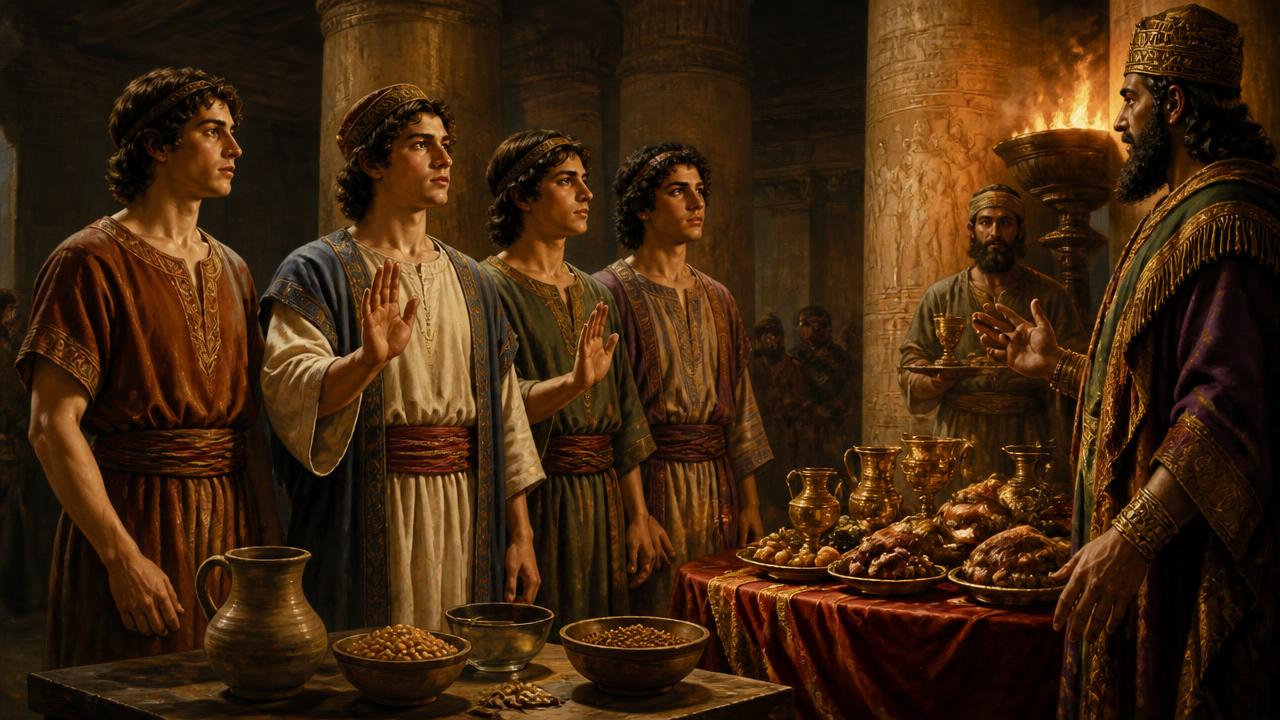
The chapter exposition
Daniel 1 — seen whole
The chapter read as one picture before any verse is opened: what the scene shows, where it sits in the continuous story, and the chain references that hold it to the rest of Scripture.
2.1 Daniel 1 — The First Test: Babylon’s Table
The history. 605 BC. Nebuchadnezzar’s first siege; Jehoiakim’s third year; the vessels of God’s house carried into the treasure house of ’s god (1:1–2). The first deportation takes the best of Judah’s youth — among them Daniel, Hananiah, Mishael, Azariah — for a three-year reprogramming: Babylon’s literature, Babylon’s language, Babylon’s names, Babylon’s table.
The exposition. Everything does to these four is identity replacement. Names carrying God’s name (Daniel, “God is my judge”; Hananiah, “Yah is gracious”; Mishael, “who is what God is?”; Azariah, “Yah has helped”) are swapped for names carrying Babylon’s gods (Belteshazzar, Shadrach, Meshach, Abednego). The point of the king’s meat and wine is the point of everything else: assimilation. “Remove the wise men in Babylon… I want to build a new Babylonian empire. If anyone should resist, they should be put to death” — the program is total.
Daniel’s response sets the book’s keynote: “Daniel purposed in his heart that he would not defile himself” (1:8). The test looks dietary; it is doxological. And it previews the last conflict precisely: “When we drink in the wine of , we’re going to be confused about what truth is” (Photo-Theology, Aug 24, 2026). The wine of Babylon in Revelation 14:8 and 17:2 is false doctrine; the first chapter of Daniel is the first refusal of that cup. The ten- test, the countenances “fairer and fatter,” the tenfold wisdom (1:20) — God vindicates the ones who let Him keep their identity.
Christ connection. The true Daniel — the one who kept His identity in the enemy’s territory, was tested on appetite in the wilderness, and stood in the judgment “God is my judge” — is Christ. Daniel 1 is the gospel in miniature: in , but not of it.
Chain references. Gen 3 (appetite as the first test) · Ex 34:28 · · Rev 14:8; 18:4 (the wine refused) · Rev 14:12 (the identity kept).
Drawn from the same framework published on The Foundations.
How this chapter is read
The symbol keys and study principles that govern this chapter. Every conclusion is checked against Scripture — follow the references and read them for yourself.
Symbol keys · 2
Wine of Babylon
Deceptive teachings or influences that lead away from God's truth
Basis: Daniel 1:8, where Daniel refuses the king's food and wine, symbolizing a rejection of Babylonian influence
Pig
Dietary laws and unclean food
Basis: Daniel 1's focus on dietary choices
Study principles · 6
Understanding the macro perspective of a biblical book helps in comprehending the individual parts within the context of the whole. By seeing the big picture, one can better understand how individual elements fit into the overall narrative.
Crisis reveals character and preparation before a test is crucial for spiritual resilience. Daniel and his friends were able to stand firm in their faith because they were prepared before the crisis came.
Each chapter of a biblical book can be viewed through multiple dimensions to uncover different layers of meaning. This approach allows for a deeper understanding of the text by considering its implications on various levels, such as personal, church, and cosmic.
The book of Daniel can be understood through five dimensions: literal, Christ, personal, church, and heavenly. These dimensions allow for a comprehensive understanding of scripture, revealing layers of meaning beyond the literal text.
The prophecies in Daniel are laid out in chronological order and can be seen as a reflection of Christ's ministry and the great controversy. This structure helps to contextualize the prophecies within the broader narrative of salvation history.
Memorize the themes of each chapter in a biblical book to quickly recall its content. This helps in understanding the overarching narrative and themes without needing to reference specific verses.
Daniel 1 — the full dossier
The long-form file on this chapter: the history behind it, the earlier Scripture standing under it, its symbols and chain references, where its principle is visible today, and the objections that attach to it. Three registers are kept distinct — documented history, internal biblical parallel, and interpretive correspondence.
The dossier is research-grade and runs 1,500 to 2,500 words. It opens at the Scholarly reading level, alongside the Old Testament roots, the present-day threads and the objections.