
Revelation 14
King James Version · 20 verses · tap a verse for its study panel
Listen to Revelation 14
The full chapter read aloud in a natural voice.
What the verse says and what it means. One reading, no tabs. Saved in this browser.
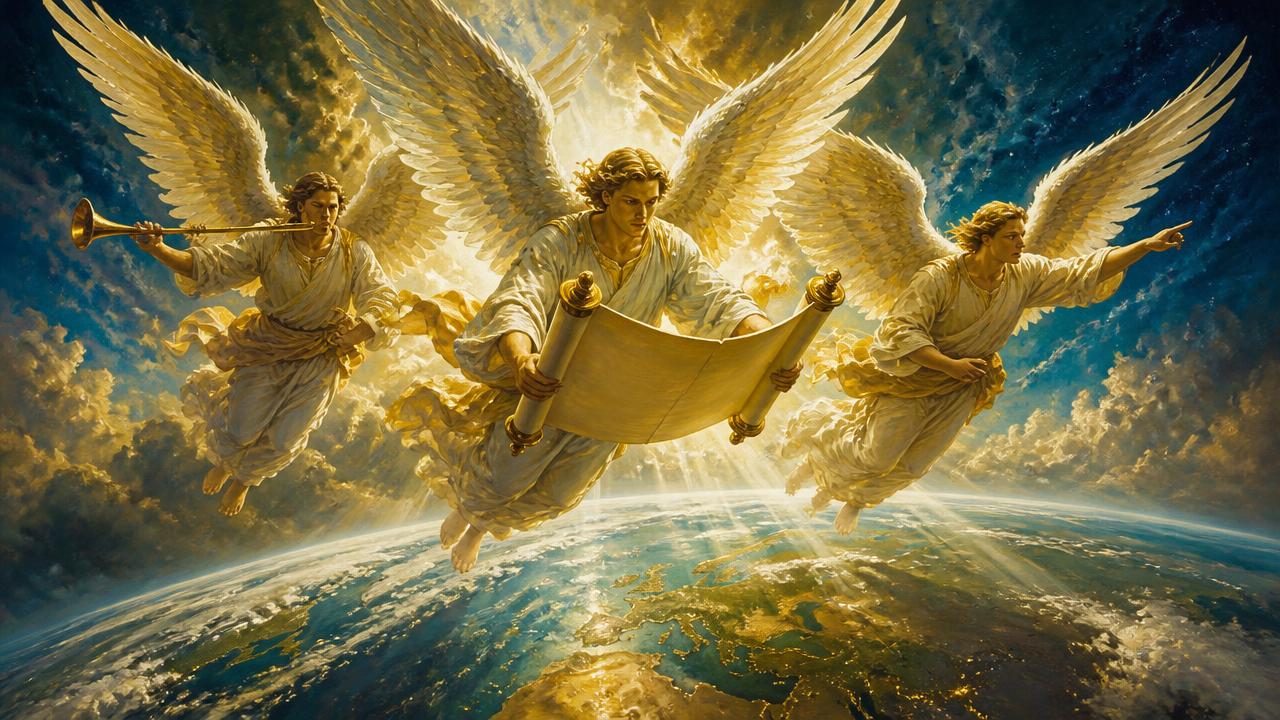
The chapter exposition
Revelation 14 — seen whole
The chapter read as one picture before any verse is opened: what the scene shows, where it sits in the continuous story, and the chain references that hold it to the rest of Scripture.
3.8 Revelation 14 — The Three Angels and the Two Harvests
The 144,000 with the (14:1–5) — the answer scene: over against the ’s marked multitude, “a Lamb stood on the mount Sion, and with him an hundred forty and four thousand, having his Father’s name written in their foreheads.” Not defiled with women — clean of the harlot and her daughters (17:5), “having come out of at the call of Revelation 18:4”; in their mouth no guile; “they follow the whithersoever he goeth”; firstfruits — the best of the harvest, the living translated (full doctrine: Part IV §4.5).
The first angel (14:6–7). “The everlasting gospel” — the same gospel, never another — carried “to every nation, and kindred, and tongue, and people,” with the hour’s edition: “Fear God, and give glory to him; for the hour of his judgment is come: and worship him that made heaven, and earth, and the , and the fountains of waters.” Judgment-hour (, Dan 7’s court, Dan 8’s cleansing) + creation-worship — the summons quotes the fourth commandment’s own words (Ex 20:11): the Sabbath is inside the first angel’s message by direct citation. Righteousness by faith is its heart: “the third angel’s message in verity” is justification by faith — the loud cry is not a new doctrine but Laodicea’s cure preached to the world (Jan 2024 series).
The second angel (14:8). “ is fallen, is fallen, that great city, because she made all nations drink of the wine of the wrath of her fornication” — Daniel 5’s verdict re-served (Isa 21:9’s exact words); moral fall first, ruin after; the announcement dated to the rejection of the first message and repeated with escalation in 18:1–4.
The third angel (14:9–12). The most solemn warning in Scripture — against the , the image, and the mark — with the wine of God’s wrath “poured out without mixture” (the plagues, unmixed with mercy, because mediation has closed) — and its photographic negative, the verse the whole corpus treats as the remnant’s portrait: “Here is the patience of the saints: here are they that keep the commandments of God, and the faith of Jesus” (14:12). Law and faith, commandments and gospel, fused — the answer to the mark is not fear but righteousness by faith keeping covenant.
The Son of man on the cloud; two harvests (14:14–20). The grain harvest reaped by the crowned Son of man — the righteous gathered; the vintage cast into “the great winepress of the wrath of God” — ’s valley, ’s trodden press; blood to the horse bridles by the space of 1600 furlongs — judgment’s totality in the idiom of the whole land.
OT roots. Ex 20:8–11 (quoted in 14:7) · Isa 21:9 (fallen, fallen) · Jer 51:7 (the golden cup) · ; Isa 63:1–6 (the harvests) · (the of wrath).
Drawn from the same framework published on The Foundations.
How this chapter is read
The symbol keys and study principles that govern this chapter. Every conclusion is checked against Scripture — follow the references and read them for yourself.
Symbol keys · 2
Mount Zion
The gathering place for all the redeemed, representing spiritual deliverance from Babylon
Basis: Isaiah 51:11 and Revelation 14:1-3 describe Mount Zion as a place of redemption and joy
Smoke of their torment
The complete and final destruction of the wicked, not ongoing torment
Basis: Psalm 37:20 and Revelation 14:11 describe the smoke as evidence of complete consumption
Study principles · 9
True worshipers are those who keep the commandments of God and have the faith of Jesus. This principle is foundational to understanding who is measured within the sanctuary.
The call to come out of Babylon signifies a choice that individuals must make regarding their spiritual state. This reflects the biblical theme of choice and separation from confusion and falsehood.
The journey of redemption is framed between two Edens, illustrating the fall and restoration of humanity. This principle highlights the overarching narrative of salvation history, showing how humanity's journey from paradise to sin and back to paradise is central to understanding redemption.
Gen 3:23Rev 14:1-4The concept of the 'first fruits' in prophecy represents those who are redeemed and brought to God, symbolizing the faithful who are saved. In Revelation 14, the 144,000 are described as first fruits, indicating their role as the redeemed.
The union of church and state will lead to the final apostasy. The merging of religious and political powers will create conditions for widespread deception.
The Day of Atonement in Revelation represents the judgment and cleansing of God's people. This is a time of judgment and purification, as seen in Revelation's latter chapters.
Lev 16Rev 14:7Understanding the overarching storylines and patterns in the Bible is crucial for interpreting its messages. Knowing the story allows one to teach and understand the Bible beyond isolated facts.
The number 144,000 in Revelation is symbolic, representing the redeemed from all ages, not a literal count of individuals. The symbolic nature of Revelation's imagery and the broader biblical context suggest a figurative interpretation.
The seal of God is a symbolic mark of belonging to God, representing His name and character written in the believer's heart. The seal signifies God's ownership and protection over His people.
Revelation 14 — the full dossier
The long-form file on this chapter: the history behind it, the earlier Scripture standing under it, its symbols and chain references, where its principle is visible today, and the objections that attach to it. Three registers are kept distinct — documented history, internal biblical parallel, and interpretive correspondence.
The dossier is research-grade and runs 1,500 to 2,500 words. It opens at the Scholarly reading level, alongside the Old Testament roots, the present-day threads and the objections.