
Daniel 5
King James Version · 31 verses · tap a verse for its study panel
Listen to Daniel 5
The full chapter read aloud in a natural voice.
What the verse says and what it means. One reading, no tabs. Saved in this browser.
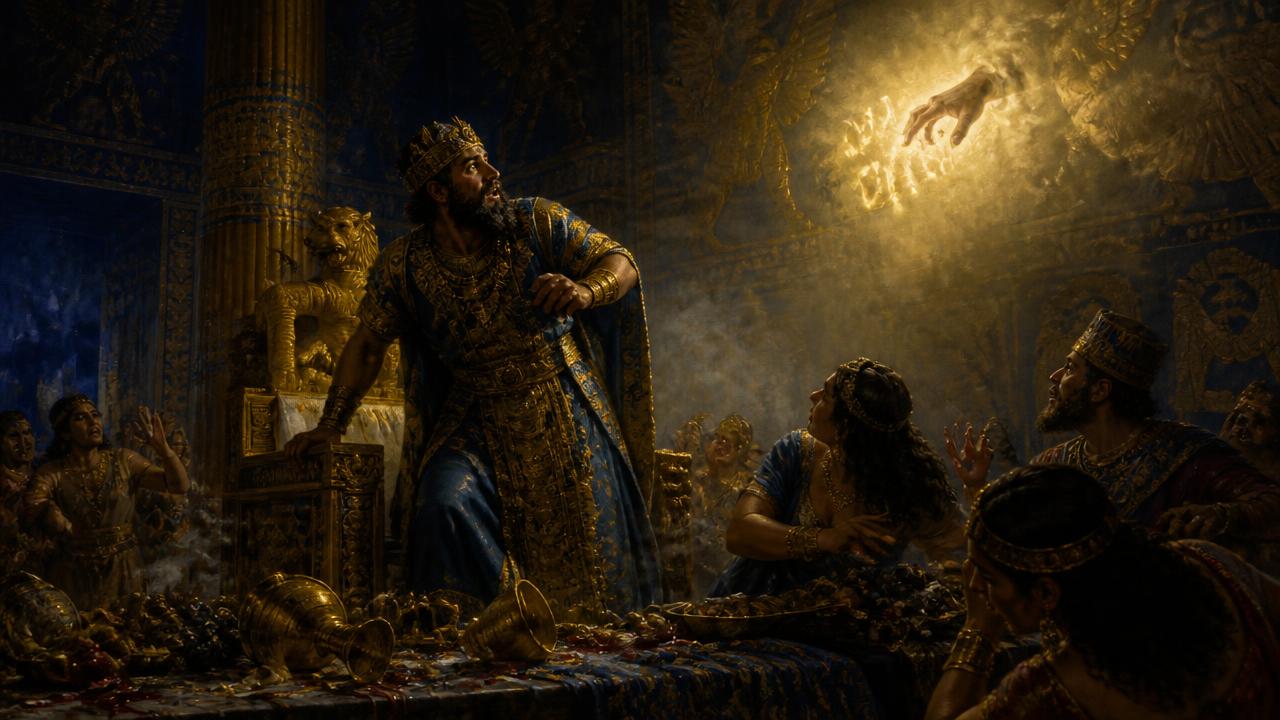
The chapter exposition
Daniel 5 — seen whole
The chapter read as one picture before any verse is opened: what the scene shows, where it sits in the continuous story, and the chain references that hold it to the rest of Scripture.
2.5 Daniel 5 — The Fall of Babylon: The Handwriting and the River
The history. October 12, 539 BC. Belshazzar feasts a thousand lords, and — the calculated blasphemy that dates every detail — calls for the vessels of the house of God to toast “the gods of gold, and of silver, of brass, of iron, of wood, and of ” (5:4). Fingers of a man’s hand write on the plaster: MENE, MENE, TEKEL, UPHARSIN. That same night, Cyrus’s forces — the river Euphrates diverted, the two-leaved gates left open (Isa 45:1) — take the city without a battle. “In that night was Belshazzar the king of the Chaldeans slain. And Darius the Median took the kingdom” (5:30–31).
The exposition. This chapter is Revelation 16–18 acted out five centuries early, and Revelation writes its finale in Daniel 5’s ink deliberately:
Daniel 5 (type) Revelation (antitype) desecrates the ’s vessels at a feast End-time holds a golden cup “full of abominations” (17:4) — truth profaned Weighed in the balances, found wanting “God hath remembered her iniquities” (18:5); judgment sits The Euphrates dried; the kings from the east enter The sixth plague dries the Euphrates “that the way of the kings of the east might be prepared” (16:12) = the city’s protection and support = “peoples, and multitudes, and nations, and tongues” (17:15); their drying = support withdrawn Cyrus, God’s anointed “from the east,” the deliverer who conquers and frees the captives (Isa 44:28–45:4) Christ, the true Anointed, comes from the east () with the kings of the east; His victory over frees His people: “Come out of her, my people” (18:4) That very night, the kingdom transfers “In one hour is thy judgment come” (18:10) The drying of the Euphrates is therefore not a Middle-East watercourse story: it is the moment the multitudes who carried end-time — the peoples on whom the harlot “sitteth” — pull their support, when the overmastering deception collapses and the deceived turn on the deceiver (Rev 17:16). The type fixes the meaning; the lexicon ( = peoples) locks it.
The moral center. Daniel to Belshazzar: “Thou knewest all this” (5:22). Belshazzar sinned against light — his grandfather’s seven-times humbling was court history. never falls for lack of evidence; it falls for despising it.
Chain references. Isa 44:24–45:7 · Jer 50–51 (the whole oracle: “her is dried up,” 51:36; “flee out of the midst of ,” 51:6, 45) · Rev 16:12–19; 17:15–18; 18:1–8.
Drawn from the same framework published on The Foundations.
How this chapter is read
The symbol keys and study principles that govern this chapter. Every conclusion is checked against Scripture — follow the references and read them for yourself.
Study principles · 1
Each chapter of a biblical book can be viewed through multiple dimensions to uncover different layers of meaning. This approach allows for a deeper understanding of the text by considering its implications on various levels, such as personal, church, and cosmic.
Daniel 5 — the full dossier
The long-form file on this chapter: the history behind it, the earlier Scripture standing under it, its symbols and chain references, where its principle is visible today, and the objections that attach to it. Three registers are kept distinct — documented history, internal biblical parallel, and interpretive correspondence.
The dossier is research-grade and runs 1,500 to 2,500 words. It opens at the Scholarly reading level, alongside the Old Testament roots, the present-day threads and the objections.