
Daniel 4
King James Version · 37 verses · tap a verse for its study panel
Listen to Daniel 4
The full chapter read aloud in a natural voice.
What the verse says and what it means. One reading, no tabs. Saved in this browser.
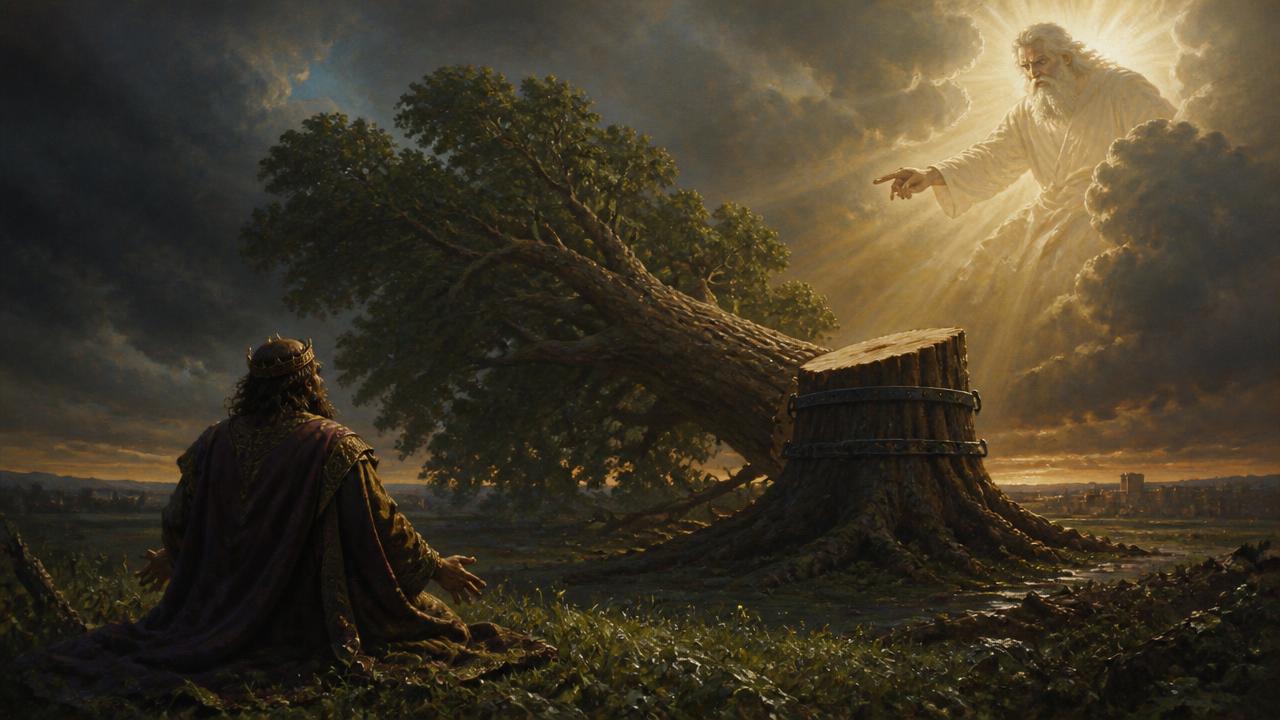
The chapter exposition
Daniel 4 — seen whole
The chapter read as one picture before any verse is opened: what the scene shows, where it sits in the continuous story, and the chain references that hold it to the rest of Scripture.
2.4 Daniel 4 — The Tree Cut Down: Heaven Rules
The history. Nebuchadnezzar’s own state paper — the only chapter of Scripture authored by a pagan king. A dream: a tree reaching heaven, feeding the world, cut down by a Watcher’s decree, its stump banded in iron and brass “till seven times pass over him.” Daniel, alarmed, interprets: the tree is the king; pride will cost him his reason; he will graze as a until he knows “that the most High ruleth in the kingdom of men” (4:25). Twelve months later, on the palace roof: “Is not this great , that I have built?” — and the word falls while the word is in his mouth.
The exposition. Daniel 4 is the anatomy of ’s disease: pride that annexes God’s glory. “Is not this great Babylon” is the Tower of Babel’s sentence spoken by its heir — “let us make us a name” (Gen 11:4) — and it is the ’s sentence (“a mouth speaking great things,” Dan 7:8), and it is end-time Babylon’s sentence: “I sit a queen, and am no widow, and shall see no sorrow” (Rev 18:7). The seven times of madness — the king driven from men, his heart made a ’s — is the Bible’s own picture of what worship-of-self does to the imago Dei: the man who will not reflect God’s image descends into the beast’s. (The same grammar underwrites Revelation’s contrast between those who receive the beast’s mark and those in whom the ’s name — His character — is written.)
And the chapter preaches grace: the stump is banded, not uprooted. The humbled king lifts his eyes to heaven, his reason returns, and the chapter ends in the most remarkable doxology a Gentile monarch ever wrote: “those that walk in pride he is able to abase” (4:37). In the three-fold parallel, Daniel 4 supplies the ending: the proud power that exalts itself against heaven is brought down at the set time — which is precisely the arc of Daniel 11:45 and Revelation 18. Nebuchadnezzar’s humbling is the merciful version of the story; -the-system refuses the mercy and gets the fall.
Chain references. Gen 11:1–9 · Isa 14:12–15 · Rev 18:7–8 · · .
Drawn from the same framework published on The Foundations.
How this chapter is read
The symbol keys and study principles that govern this chapter. Every conclusion is checked against Scripture — follow the references and read them for yourself.
Symbol keys · 1
The tree in Nebuchadnezzar's vision
Nebuchadnezzar and the kingdom of Babylon
Basis: Daniel 4 uses the tree as a symbol of Nebuchadnezzar's pride and subsequent downfall
Study principles · 3
Each chapter of a biblical book can be viewed through multiple dimensions to uncover different layers of meaning. This approach allows for a deeper understanding of the text by considering its implications on various levels, such as personal, church, and cosmic.
The transformation from a beast's heart to a man's heart symbolizes spiritual conversion and understanding. Nebuchadnezzar's story illustrates the change from ignorance to understanding through divine intervention.
Trials can refine individuals, transforming them into something valuable. The experience of Nebuchadnezzar illustrates how trials can lead to spiritual awakening and redemption.
Daniel 4 — the full dossier
The long-form file on this chapter: the history behind it, the earlier Scripture standing under it, its symbols and chain references, where its principle is visible today, and the objections that attach to it. Three registers are kept distinct — documented history, internal biblical parallel, and interpretive correspondence.
The dossier is research-grade and runs 1,500 to 2,500 words. It opens at the Scholarly reading level, alongside the Old Testament roots, the present-day threads and the objections.