
Act II · Milestone 4 of 5
Daniel 9 — Seventy Weeks
An old man prays over an open Bible, an angel returns to finish an unfinished explanation, and the result is the one prophecy that puts a calendar on the cross.
Daniel 9 · about 18 minutes
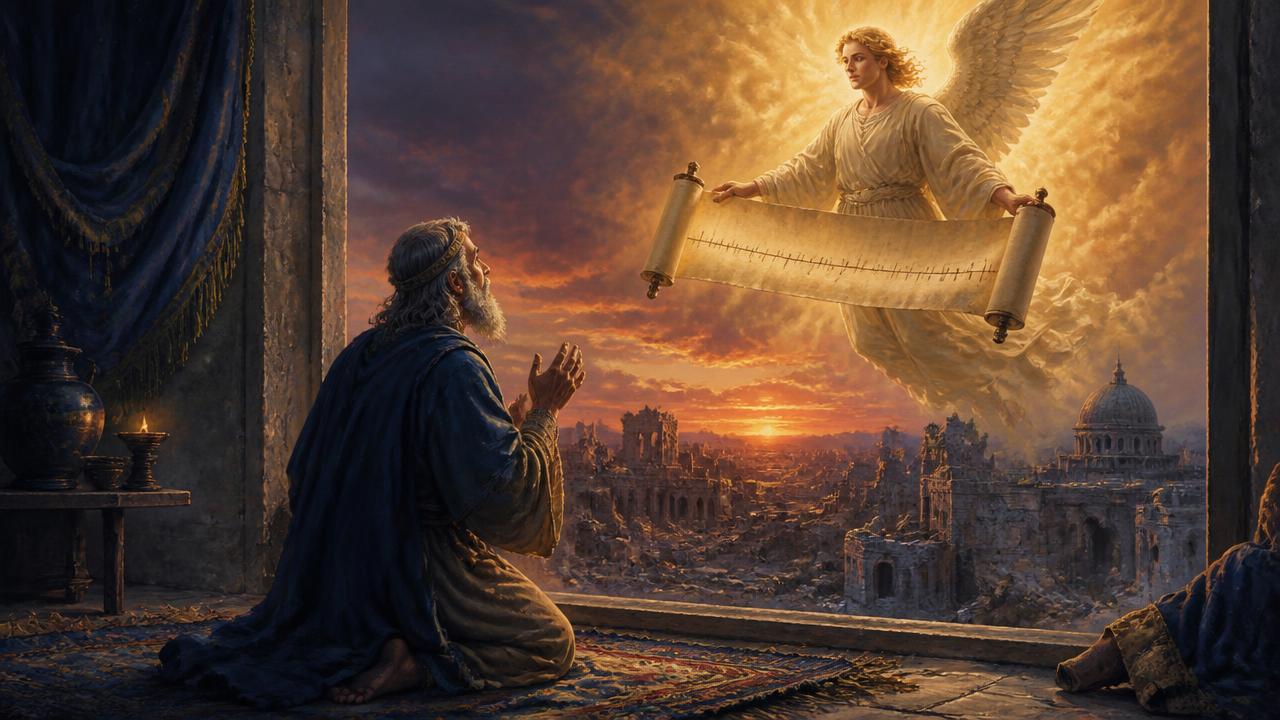
2In the first year of his reign I Daniel understood by books the number of the years, whereof the word of the LORD came to Jeremiah the prophet, that he would accomplish seventy years in the desolations of Jerusalem.
20And whiles I was speaking, and praying, and confessing my sin and the sin of my people Israel, and presenting my supplication before the LORD my God for the holy mountain of my God;
21Yea, whiles I was speaking in prayer, even the man Gabriel, whom I had seen in the vision at the beginning, being caused to fly swiftly, touched me about the time of the evening oblation.
22And he informed me, and talked with me, and said, O Daniel, I am now come forth to give thee skill and understanding.
23At the beginning of thy supplications the commandment came forth, and I am come to shew thee; for thou art greatly beloved: therefore understand the matter, and consider the vision.
24Seventy weeks are determined upon thy people and upon thy holy city, to finish the transgression, and to make an end of sins, and to make reconciliation for iniquity, and to bring in everlasting righteousness, and to seal up the vision and prophecy, and to anoint the most Holy.
25Know therefore and understand, that from the going forth of the commandment to restore and to build Jerusalem unto the Messiah the Prince shall be seven weeks, and threescore and two weeks: the street shall be built again, and the wall, even in troublous times.
26And after threescore and two weeks shall Messiah be cut off, but not for himself: and the people of the prince that shall come shall destroy the city and the sanctuary; and the end thereof shall be with a flood, and unto the end of the war desolations are determined.
27And he shall confirm the covenant with many for one week: and in the midst of the week he shall cause the sacrifice and the oblation to cease, and for the overspreading of abominations he shall make it desolate, even until the consummation, and that determined shall be poured upon the desolate.
Watch the scene first
538 BC. Daniel is reading Jeremiah and counting years: seventy of them, and the exile is nearly up. So he prays the great confession of the Bible — "we have sinned… O Lord, hear; O Lord, forgive" — and while he is still speaking, Gabriel arrives "about the time of the evening oblation," touched with weariness from flight. His opening words tie the chapter to the last one: "I am now come forth to give thee skill and understanding… consider the vision." Which vision? The one Daniel fainted through in chapter 8 — the one whose time element was never explained.
Seventy weeks cut off from the 2300
"Seventy weeks are determined upon thy people and upon thy holy city." The verb translated "determined" carries the sense of being cut off — severed from something longer. There is only one longer period on the table: the 2300 days of chapter 8. So 490 years are cut off the front of the 2300 for Israel, and both periods start together, at the same starting pistol: "from the going forth of the commandment to restore and to build Jerusalem."
Which decree starts the clock
Four royal acts touch Jerusalem: Cyrus in 538 BC and Darius in 520 BC, both concerning the temple; Artaxerxes to Ezra in 457 BC; and Artaxerxes to Nehemiah about 444 BC, for the walls, issued under the standing authority of the earlier decree. The commandment to restore the city — not just the temple — is completed in 457 BC, when Ezra is authorized to "set magistrates and judges" and the civil life of Jerusalem is restored. Ezra himself speaks of the whole work as finished "according to the commandment of Cyrus, and Darius, and Artaxerxes king of Persia" — three decrees treated as one commandment, complete at the last of them.
The arithmetic that lands on Christ
457 BC plus 49 years (the seven weeks) reaches 408 BC — the street and wall rebuilt "in troublous times." 457 BC plus 483 years (sixty-nine weeks) reaches AD 27 — "unto the Messiah the Prince." Messiah means Anointed; Jesus is anointed with the Holy Spirit at His baptism in the fifteenth year of Tiberius, and begins preaching, "The time is fulfilled." Which time? This one. Then, "in the midst of the week he shall cause the sacrifice and the oblation to cease" — AD 31, the cross, where the veil of the temple is torn from top to bottom by a hand that clearly began at the top. And the seventieth week closes in AD 34, when the gospel turns decisively to the Gentiles. Seventy weeks end; the 2300 years keep running, 1810 more, to 1844.
The one covenant, confirmed
"He shall confirm the covenant with many for one week." Read the pronoun back to its antecedent and it is the Messiah of verses 25 and 26 — He confirms, He does not initiate, an everlasting covenant that was already old in Abraham's day. That single observation removes the need for the gap theory: there is no textual signal detaching the seventieth week from the sixty-nine that precede it, and no reason to look for a future figure to make a treaty. The week runs on, unbroken, from AD 27 to AD 34, and its center is a cross.
Why this prophecy is the anchor of both books
Everything the chapter promises in verse 24 is fulfilled at Calvary and after: to finish the transgression, to make an end of sins, to make reconciliation for iniquity, to bring in everlasting righteousness, to seal up the vision and prophecy, and to anoint the most Holy. A prophecy given five centuries early names the decade, the year and the manner of the Messiah's death — which is precisely why the seventy weeks are the standing evidence that the 2300 days are trustworthy too. They share a starting date. If the first 490 years landed exactly, the remaining 1810 are running on the same clock.
Check what you saw
Two questions on this scene. Answers show an explanation either way.
What is Daniel doing when Gabriel arrives?
What does the prophecy's central week describe?
Talk it through
- —How does a dated starting decree change the way you weigh the prophecy?
- —Why is confession the setting for the clearest time prophecy in the book?
Good prompts for a study group, or for the reflection journal on the Today page.