
Act II · Milestone 5 of 5
Daniel 10–12 — The Long Cut
One final vision in three chapters: the unseen war behind politics, two hundred years of kings told in plain speech, and Michael standing up at the end of it all.
Daniel 10–12 · about 22 minutes
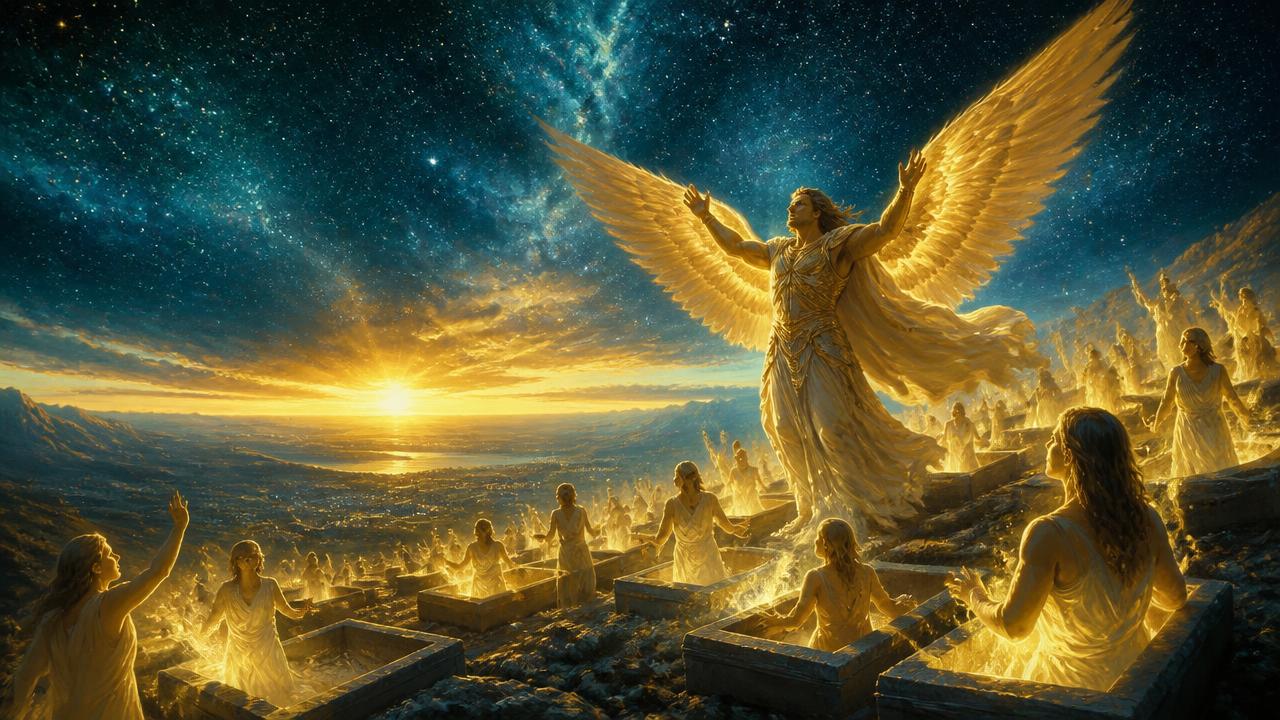
10:5Then I lifted up mine eyes, and looked, and behold a certain man clothed in linen, whose loins were girded with fine gold of Uphaz:
10:6His body also was like the beryl, and his face as the appearance of lightning, and his eyes as lamps of fire, and his arms and his feet like in colour to polished brass, and the voice of his words like the voice of a multitude.
10:13But the prince of the kingdom of Persia withstood me one and twenty days: but, lo, Michael, one of the chief princes, came to help me; and I remained there with the kings of Persia.
10:21But I will shew thee that which is noted in the scripture of truth: and there is none that holdeth with me in these things, but Michael your prince.
11:2And now will I shew thee the truth. Behold, there shall stand up yet three kings in Persia; and the fourth shall be far richer than they all: and by his strength through his riches he shall stir up all against the realm of Grecia.
11:22And with the arms of a flood shall they be overflown from before him, and shall be broken; yea, also the prince of the covenant.
11:31And arms shall stand on his part, and they shall pollute the sanctuary of strength, and shall take away the daily sacrifice, and they shall place the abomination that maketh desolate.
11:40And at the time of the end shall the king of the south push at him: and the king of the north shall come against him like a whirlwind, with chariots, and with horsemen, and with many ships; and he shall enter into the countries, and shall overflow and pass over.
12:1And at that time shall Michael stand up, the great prince which standeth for the children of thy people: and there shall be a time of trouble, such as never was since there was a nation even to that same time: and at that time thy people shall be delivered, every one that shall be found written in the book.
12:2And many of them that sleep in the dust of the earth shall awake, some to everlasting life, and some to shame and everlasting contempt.
12:3And they that be wise shall shine as the brightness of the firmament; and they that turn many to righteousness as the stars for ever and ever.
12:4But thou, O Daniel, shut up the words, and seal the book, even to the time of the end: many shall run to and fro, and knowledge shall be increased.
12:13But go thou thy way till the end be: for thou shalt rest, and stand in thy lot at the end of the days.
Watch the scene first
Chapters 10, 11 and 12 are a single vision — the last one Daniel receives. It opens on the bank of the Tigris with an appearance that stops the prophet's strength: a man clothed in linen, loins girded with gold, body like beryl, face like lightning, eyes like lamps of fire, voice like the voice of a multitude. John will describe the glorified Christ feature for feature in the same words. Then a hand touches Daniel, and the reading of "the scripture of truth" begins.
Chapter 10 — what politics actually is
Before a single king is named, this chapter tells you what you are looking at. "The prince of the kingdom of Persia withstood me one and twenty days: but, lo, Michael, one of the chief princes, came to help me." Behind the visible court of Persia stands an unseen resistance; behind that stands Michael. Earth's history is the visible wake of an invisible war — and Daniel's three weeks of fasting were precisely the three weeks of the contest, which means prayer is not a spectator's activity in this conflict. The cast is set here: Gabriel the narrator, and Michael, "your prince," who appears twice — helping in the unseen war, and standing up to end it.
Chapter 11 — the same six beats, in plain speech
Read the whole chapter — "the meat is in the entire chapter", not only in its last six verses. Its structure follows the timelines you already know: verses 1-22 cover the era the seventy weeks measure, verses 23-39 the era the 1260 years measure, and verses 40-45 the time of the end. It opens with Persia and a rich fourth king who stirs up all against Greece; then "a mighty king" whose kingdom is broken and "divided toward the four winds… and not to his posterity" — the four horns of chapter 8 again. Then the long seesaw of the kings of the south and north, Egypt and Syria, tracked marriage by marriage and campaign by campaign. Then Rome: the power that comes and stands "in the glorious land," the raiser of taxes whose census walks Joseph and Mary to Bethlehem, and finally verse 22 — "the prince of the covenant" broken. The section that measures the seventy weeks closes on the cross, exactly where chapter 9 said it would.
Earlier presentations emphasized verses 40–45; the current teaching (2026) reads the whole chapter — Persia, Greece, the Ptolemies and Seleucids, Rome pagan and papal, then the end.
Chapter 11 continued — the long middle and the end
The southern banner changes hands as the chapter moves: Egypt held it among the literal kings, Islam bore it through the 1260 era, and atheism bears it at the time of the end — one title, three bearers. From verse 23 the chapter walks the same career Daniel 7 and 8 described, now in prose: a league that turns a small power into a strong one, arms that "pollute the sanctuary of strength" and take away the daily, the faithful who "instruct many" and fall by sword and flame "many days," and a purging that runs "even to the time of the end." Then verse 40 opens the last act — "and at the time of the end" — with a push from the south and a whirlwind answer from the north. Read on the map this chapter has been building, these are not modern nation-states but the two enduring forms of opposition to God's people: open defiance of God, whose oldest voice is Pharaoh's "Who is the LORD, that I should obey his voice?", and the counterfeit worship that operates from inside religion. The chapter ends with the northern power planting "the tabernacles of his palace between the seas in the glorious holy mountain" — a final claim to God's own seat — "yet he shall come to his end, and none shall help him."
Chapter 12 — why Michael stands up
"And at that time shall Michael stand up, the great prince which standeth for the children of thy people." Why stand? Because the court of Daniel 7 has been sitting. A judge sits to judge and stands when judgment is finished and execution begins. Michael's standing is the close of mediation — "he that is unjust, let him be unjust still… he that is holy, let him be holy still" — followed by "a time of trouble, such as never was since there was a nation." And in the same verse: "at that time thy people shall be delivered, every one that shall be found written in the book." The furnace of Daniel 3 already taught you how that deliverance works: not without trouble, but not without a Presence either.
Sealed till the time of the end
"Shut up the words, and seal the book, even to the time of the end: many shall run to and fro, and knowledge shall be increased." The book dates its own unsealing — the era after 1798, when Daniel was reopened worldwide. Three closing numbers hang on the same hinge: the time, times and half a time (1260 years, 538–1798), the 1290, and the 1335, with its beatitude, "Blessed is he that waiteth." And the last word spoken to Daniel is the invitation this whole journey has been building toward: "But go thou thy way till the end be: for thou shalt rest, and stand in thy lot at the end of the days."
Check what you saw
Two questions on this scene. Answers show an explanation either way.
How does Daniel 11 tell its story?
What does chapter 12 close with?
Talk it through
- —Why does the book get plainer, not more mysterious, as it ends?
- —What does 'many shall run to and fro' suggest about study at the end?
Good prompts for a study group, or for the reflection journal on the Today page.