
Act II · Milestone 3 of 5
Daniel 8 — Ram & Goat
Two symbols the Bible names outright, a horn that grows exceeding great, and the longest time prophecy in Scripture — with the camera now inside the sanctuary.
Daniel 8 · about 15 minutes
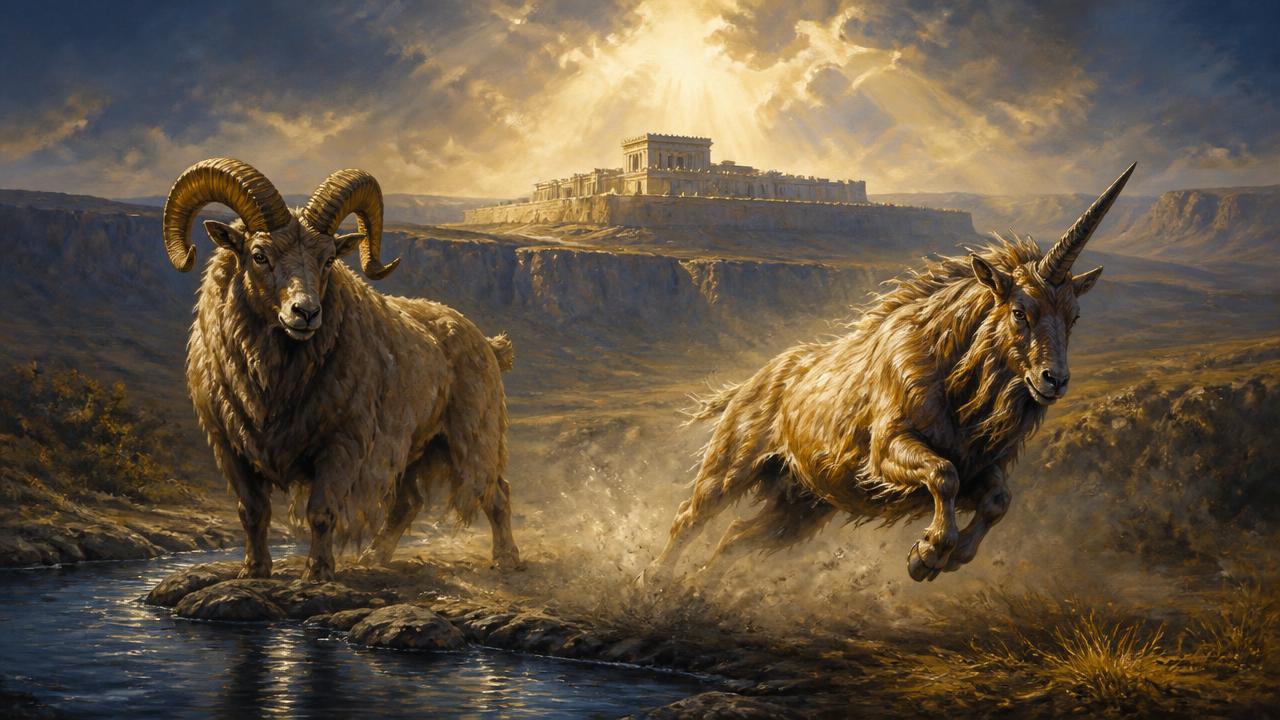
3Then I lifted up mine eyes, and saw, and, behold, there stood before the river a ram which had two horns: and the two horns were high; but one was higher than the other, and the higher came up last.
4I saw the ram pushing westward, and northward, and southward; so that no beasts might stand before him, neither was there any that could deliver out of his hand; but he did according to his will, and became great.
5And as I was considering, behold, an he goat came from the west on the face of the whole earth, and touched not the ground: and the goat had a notable horn between his eyes.
8Therefore the he goat waxed very great: and when he was strong, the great horn was broken; and for it came up four notable ones toward the four winds of heaven.
9And out of one of them came forth a little horn, which waxed exceeding great, toward the south, and toward the east, and toward the pleasant land.
10And it waxed great, even to the host of heaven; and it cast down some of the host and of the stars to the ground, and stamped upon them.
11Yea, he magnified himself even to the prince of the host, and by him the daily sacrifice was taken away, and the place of his sanctuary was cast down.
12And an host was given him against the daily sacrifice by reason of transgression, and it cast down the truth to the ground; and it practised, and prospered.
13Then I heard one saint speaking, and another saint said unto that certain saint which spake, How long shall be the vision concerning the daily sacrifice, and the transgression of desolation, to give both the sanctuary and the host to be trodden under foot?
14And he said unto me, Unto two thousand and three hundred days; then shall the sanctuary be cleansed.
20The ram which thou sawest having two horns are the kings of Media and Persia.
21And the rough goat is the king of Grecia: and the great horn that is between his eyes is the first king.
25And through his policy also he shall cause craft to prosper in his hand; and he shall magnify himself in his heart, and by peace shall destroy many: he shall also stand up against the Prince of princes; but he shall be broken without hand.
26And the vision of the evening and the morning which was told is true: wherefore shut thou up the vision; for it shall be for many days.
Watch the scene first
A ram stands by a river with two horns, one higher than the other, and it pushes westward, northward and southward until nothing can stand before it. Then a he-goat comes from the west so fast it does not touch the ground, with one notable horn between its eyes, and it smashes the ram. At the height of its strength the great horn is broken, and four horns come up in its place toward the four winds. Out of one of those winds comes a little horn — and this one grows "exceeding great," and then does something no earlier power in the book has done: it reaches up toward heaven itself.
The Bible names its own symbols
You do not have to guess here, and that is the point of putting this chapter in front of a newcomer. Verse 20: "The ram which thou sawest having two horns are the kings of Media and Persia." Verse 21: "the rough goat is the king of Grecia: and the great horn that is between his eyes is the first king." Alexander's empire divided four ways at his death, exactly as verse 22 says — "four kingdoms shall stand up out of the nation, but not in his power." The chapter simply resumes the sequence of Daniel 2 and 7, starting at Medo-Persia because Babylon is already ending.
The graded comparison that settles the horn
Read the adjectives in order, because the chapter is grading these powers deliberately. Medo-Persia "became great" (v. 4). Greece "waxed very great" (v. 8). The little horn "waxed exceeding great" (v. 9). Whatever this power is, the text requires it to exceed Alexander's empire — and it grows "toward the south, and toward the east, and toward the pleasant land," which is Rome's actual line of march: Egypt, Syria and Asia, Judea. It "was little" and "became exceeding great" — the city-state that became the world. This is why the historicist reading identifies the horn as Rome, pagan and then papal, and why a minor Seleucid king who was turned back from Egypt by a Roman ultimatum and died in a failed eastern campaign cannot answer to the specification. He never exceeded even his own dynasty's founder, let alone Greece.
The camera tilts up into the sanctuary
"It waxed great, even to the host of heaven… yea, he magnified himself even to the prince of the host, and by him the daily sacrifice was taken away, and the place of his sanctuary was cast down." Pagan Rome stood against the Prince of the host at the cross and destroyed the earthly temple in AD 70. But the prophecy cannot stop there, because after AD 70 there is still a sanctuary to attack — the heavenly one, where Christ ministers as high priest. The later attack is on that ministry: a human priesthood interposed in front of Christ's intercession, a repeated sacrifice in place of the once-for-all offering, a human head over the church's true Head. "It cast down the truth to the ground; and it practised, and prospered."
"How long?" — 2300 days
A holy one asks the question every reader is already asking: how long? The answer is "unto two thousand and three hundred days; then shall the sanctuary be cleansed." A symbolic vision takes symbolic time, and the Bible's own key — a day for a year — makes this 2300 years, the longest time prophecy in Scripture. Gabriel is told, "make this man to understand the vision," but Daniel faints before the time element is explained, and the chapter ends with him "astonished at the vision, but none understood it." That unfinished explanation is the reason chapter 9 exists.
Where it lands, and what it is about
Anchored at 457 BC — the date chapter 9 supplies — the 2300 years reach AD 1844. Not the Second Coming; the text does not say the earth is cleansed, it says the sanctuary is. Leviticus 16 gives the pattern: the Day of Atonement, when the sanctuary itself is cleansed and every case is settled — which is precisely the courtroom Daniel 7 already showed you, now dated. Everything in this chapter is about Christ's ministry: the daily is His continual intercession, the sanctuary is His throne room, the cleansing is His final atoning work, and the Prince of princes is Himself.
Check what you saw
Two questions on this scene. Answers show an explanation either way.
What are the ram and the goat identified as inside the chapter?
What is the new arena in Daniel 8?
Talk it through
- —Why would a prophecy about empires end up talking about a sanctuary?
- —What does 'cast down the truth to the ground' describe in practice?
Good prompts for a study group, or for the reflection journal on the Today page.