
Act I · Milestone 5 of 5
Daniel 6 — The Lions
A law that makes prayer illegal for thirty days, an old man who opens his windows anyway, and a den that could not hold him.
Daniel 6 · about 8 minutes
4Then the presidents and princes sought to find occasion against Daniel concerning the kingdom; but they could find none occasion nor fault; forasmuch as he was faithful, neither was there any error or fault found in him.
5Then said these men, We shall not find any occasion against this Daniel, except we find it against him concerning the law of his God.
7All the presidents of the kingdom, the governors, and the princes, the counsellors, and the captains, have consulted together to establish a royal statute, and to make a firm decree, that whosoever shall ask a petition of any God or man for thirty days, save of thee, O king, he shall be cast into the den of lions.
10Now when Daniel knew that the writing was signed, he went into his house; and his windows being open in his chamber toward Jerusalem, he kneeled upon his knees three times a day, and prayed, and gave thanks before his God, as he did aforetime.
16Then the king commanded, and they brought Daniel, and cast him into the den of lions. Now the king spake and said unto Daniel, Thy God whom thou servest continually, he will deliver thee.
20And when he came to the den, he cried with a lamentable voice unto Daniel: and the king spake and said to Daniel, O Daniel, servant of the living God, is thy God, whom thou servest continually, able to deliver thee from the lions?
21Then said Daniel unto the king, O king, live for ever.
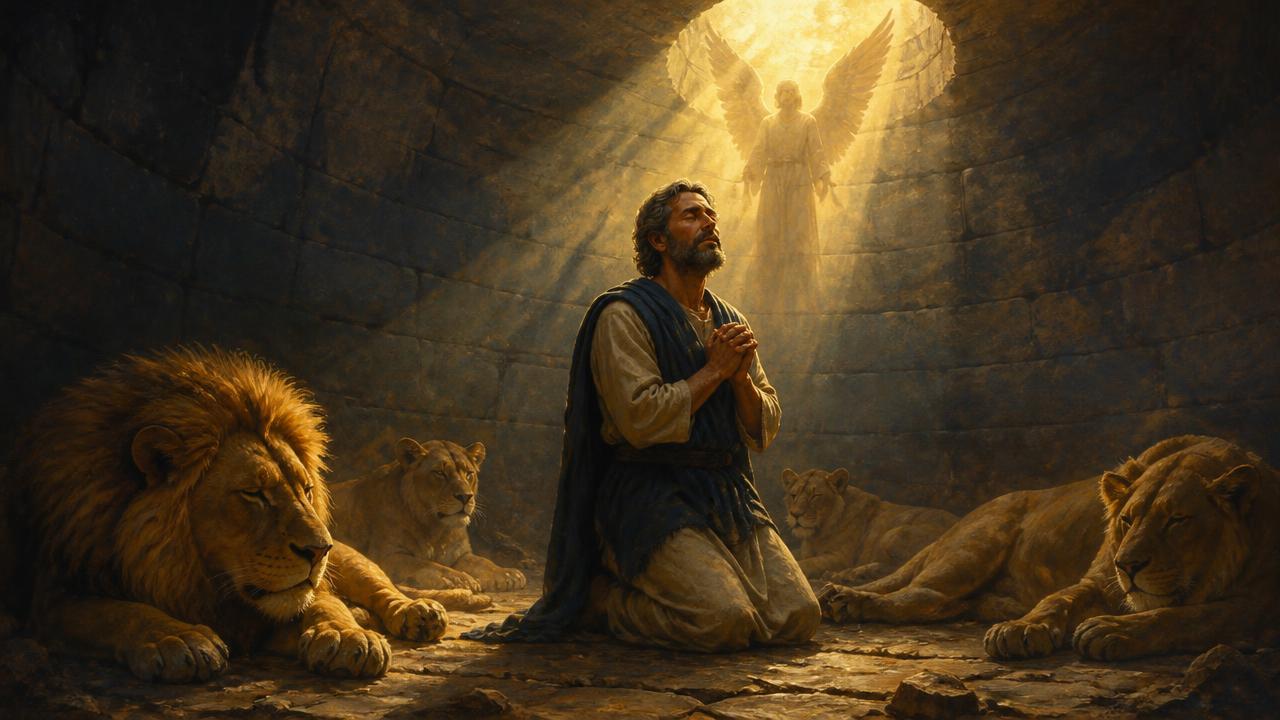
22My God hath sent his angel, and hath shut the lions’ mouths, that they have not hurt me: forasmuch as before him innocency was found in me; and also before thee, O king, have I done no hurt.
23Then was the king exceeding glad for him, and commanded that they should take Daniel up out of the den. So Daniel was taken up out of the den, and no manner of hurt was found upon him, because he believed in his God.
26I make a decree, That in every dominion of my kingdom men tremble and fear before the God of Daniel: for he is the living God, and stedfast for ever, and his kingdom that which shall not be destroyed, and his dominion shall be even unto the end.
Watch the scene first
The empire has changed hands, and Daniel — now in his eighties — is promoted over the whole realm "because an excellent spirit was in him." His colleagues look for dirt and find none: "they could find none occasion nor fault; forasmuch as he was faithful." So they change tactics with a sentence that ought to be famous: "We shall not find any occasion against this Daniel, except we find it against him concerning the law of his God." Thirty days, no petition to any god or man except the king, and the penalty is lions.
The mirror image of Daniel 3
Put the two narratives together and you have both faces of the final crisis. In chapter 3 the state commands false worship. In chapter 6 the state criminalizes true worship. Revelation shows both: an image that must be worshipped, and buying and selling withheld from those who keep the commandments of God — with the dragon's anger aimed precisely at "them which keep the commandments of God, and have the testimony of Jesus Christ." The trap here is procedurally perfect, legally unbreakable, and aimed at a man whose only offense is fidelity.
"As he did aforetime"
Watch Daniel's response, because it is deliberately unspectacular. He knows the writing is signed; he goes home; he opens his windows toward Jerusalem; he kneels three times a day "as he did aforetime." No protest, no hiding, no performance. The saints do not begin faithfulness at the crisis — the crisis simply reveals the faithfulness that habit already built. That is the most practical sentence in this milestone.
The king who could not sleep
Darius spends the night fasting, refuses music, and runs to the den at dawn crying out with "a lamentable voice." The law he signed could not be altered — even by him. This is what happens whenever civil power is handed jurisdiction over conscience: it binds the ruler as surely as the ruled. And the answer that comes up out of the den is quiet: "My God hath sent his angel, and hath shut the lions' mouths."
A sealed stone, and a morning
A stone is laid on the mouth of the den and sealed with the king's own signet, so that nothing about Daniel's case can be changed. In the morning the stone comes off and God's faithful servant walks out alive, "because he believed in his God." It is impossible to read that without hearing a greater Sunday morning in it — and the chapter ends with a pagan emperor decreeing that men everywhere tremble before the God of Daniel, "for he is the living God, and stedfast for ever."
Check what you saw
Two questions on this scene. Answers show an explanation either way.
How is Daniel trapped in chapter 6?
What does the king discover about his own decree?
Talk it through
- —Why does the story stress that the law was legal and orderly?
- —What does 'as he did aforetime' say about habit under pressure?
Good prompts for a study group, or for the reflection journal on the Today page.