
Act II · Milestone 1 of 5
Daniel 2 — The Statue
A king wakes up shaken. By the end of the chapter you can see the whole sweep of world history standing in one figure — and you know how it ends.
Daniel 2:31-45 · about 14 minutes
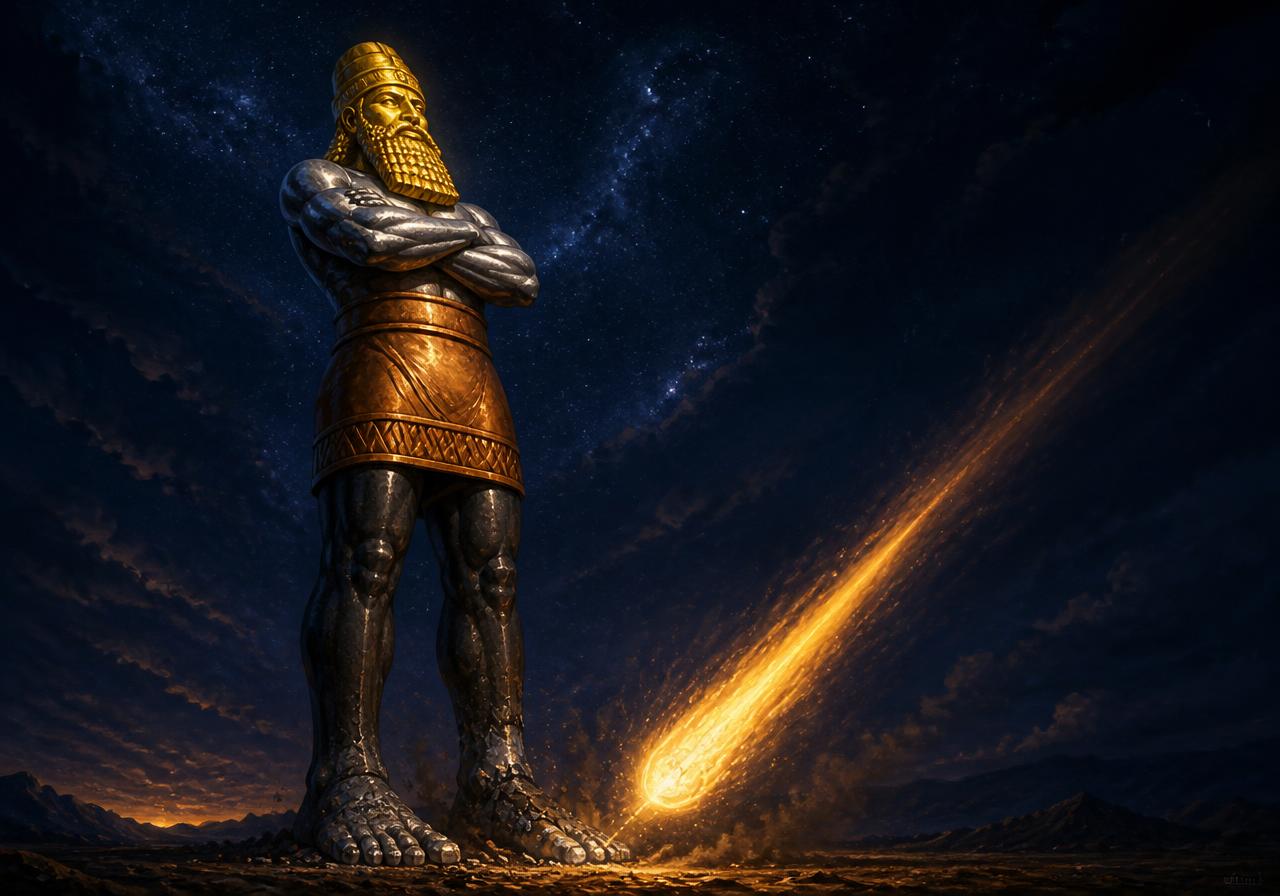
31Thou, O king, sawest, and behold a great image. This great image, whose brightness was excellent, stood before thee; and the form thereof was terrible.
32This image's head was of fine gold, his breast and his arms of silver, his belly and his thighs of brass,
33His legs of iron, his feet part of iron and part of clay.
34Thou sawest till that a stone was cut out without hands, which smote the image upon his feet that were of iron and clay, and brake them to pieces.
35Then was the iron, the clay, the brass, the silver, and the gold, broken to pieces together, and became like the chaff of the summer threshingfloors; and the wind carried them away, that no place was found for them: and the stone that smote the image became a great mountain, and filled the whole earth.
38Thou art this head of gold.
39And after thee shall arise another kingdom inferior to thee, and another third kingdom of brass, which shall bear rule over all the earth.
40And the fourth kingdom shall be strong as iron: forasmuch as iron breaketh all these in pieces, so shall it break in pieces and bruise.
41And whereas thou sawest the feet and toes, part of potters' clay, and part of iron, the kingdom shall be divided; but there shall be in it of the strength of the iron.
43And whereas thou sawest iron mixed with miry clay, they shall mingle themselves with the seed of men: but they shall not cleave one to another, even as iron is not mixed with clay.
44And in the days of these kings shall the God of heaven set up a kingdom, which shall never be destroyed: and the kingdom shall not be left to other people, but it shall break in pieces and consume all these kingdoms, and it shall stand for ever.
Watch the scene first
Do not start by decoding. Start by looking. A huge metal man stands in front of you, bright and frightening. Top to bottom he changes material: gold, then silver, then brass, then iron, then a strange mixture of iron and baked clay at the feet. Then something moves — a stone, cut out by no human hand, flies in low and hits the feet. Not the head. The feet. The whole figure collapses at once and blows away like chaff, and the stone keeps growing until it fills the earth.
The one thing the Bible tells you outright
You never have to guess at the first metal. Daniel says to Nebuchadnezzar, “Thou art this head of gold” (v. 38). That single sentence is the key that opens the rest: if the head is a kingdom, every other section is a kingdom too. Scripture hands you the starting point and lets the pattern carry you the rest of the way.
Four kingdoms, then a fracture
After Babylon comes “another kingdom inferior to thee” — Medo-Persia, the empire that took Babylon in a single night (Daniel 5:28, 30-31). After it, a “third kingdom of brass” — Greece, named plainly later in Daniel 8:21. Then a fourth, “strong as iron,” that breaks everything in pieces: Rome. But the statue does not end in a fifth empire. The legs split into feet of iron mixed with clay: “the kingdom shall be divided” (v. 41). Rome broke into the nations of Europe, and verse 43 says something remarkable — they “shall not cleave one to another.” Empire after empire has tried to reunite them. None has.
Why the stone hits the feet
The stone does not strike the gold head. It strikes the feet — the last stage, the divided one. That timing is the point: “in the days of these kings shall the God of heaven set up a kingdom” (v. 44). The kingdom of God does not arrive by human politics or by any empire's revival. It arrives from outside history and outlasts all of it: “it shall stand for ever.”
Keep this shape in your head
Babylon → Medo-Persia → Greece → Rome → divided kingdoms → God's eternal kingdom. Six beats. Once you can see them, everything later in Daniel will feel familiar — because the next visions tell you this same story again, each time with more detail added. Daniel 7 gives the kingdoms faces. Daniel 8 takes you into the sanctuary. Daniel 11 walks it out king by king. Same story. Bigger screen.
Check what you saw
Two questions on this scene. Answers show an explanation either way.
What does the statue's sequence of metals picture?
Where does the stone come from, and what does it do?
Talk it through
- —Why is the metal getting less valuable but harder as the sequence runs?
- —What does 'the iron shall not cleave' say about attempts to reunify by policy?
Good prompts for a study group, or for the reflection journal on the Today page.