
Act I · Milestone 4 of 5
Daniel 5 — The Writing on the Wall
A thousand lords, the sanctuary's stolen cups raised to idols, a hand that writes on plaster — and an empire that changes hands before morning.
Daniel 5 · about 8 minutes
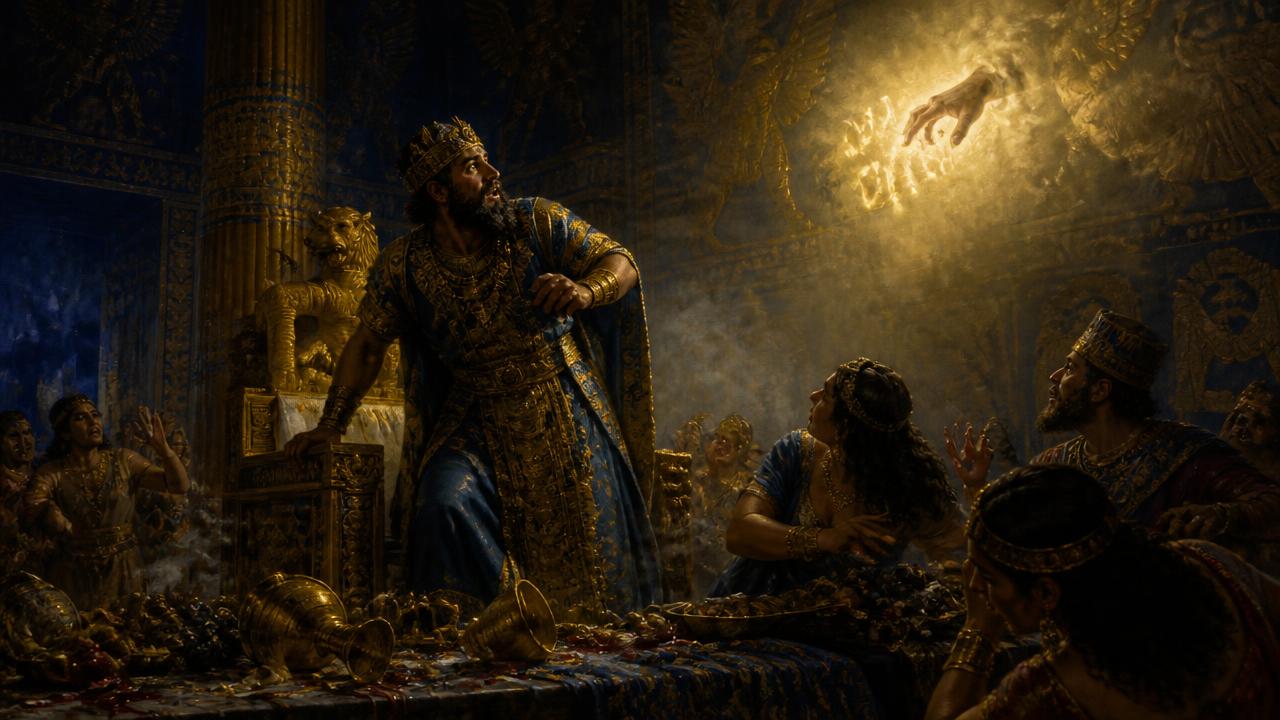
2Belshazzar, whiles he tasted the wine, commanded to bring the golden and silver vessels which his father Nebuchadnezzar had taken out of the temple which was in Jerusalem; that the king, and his princes, his wives, and his concubines, might drink therein.
3Then they brought the golden vessels that were taken out of the temple of the house of God which was at Jerusalem; and the king, and his princes, his wives, and his concubines, drank in them.
4They drank wine, and praised the gods of gold, and of silver, of brass, of iron, of wood, and of stone.
5In the same hour came forth fingers of a man’s hand, and wrote over against the candlestick upon the plaister of the wall of the king’s palace: and the king saw the part of the hand that wrote.
22And thou his son, O Belshazzar, hast not humbled thine heart, though thou knewest all this;
23But hast lifted up thyself against the Lord of heaven; and they have brought the vessels of his house before thee, and thou, and thy lords, thy wives, and thy concubines, have drunk wine in them; and thou hast praised the gods of silver, and gold, of brass, iron, wood, and stone, which see not, nor hear, nor know: and the God in whose hand thy breath is, and whose are all thy ways, hast thou not glorified:
25And this is the writing that was written, MENE, MENE, TEKEL, UPHARSIN.
26This is the interpretation of the thing: MENE; God hath numbered thy kingdom, and finished it.
27TEKEL; Thou art weighed in the balances, and art found wanting.
28PERES; Thy kingdom is divided, and given to the Medes and Persians.
30In that night was Belshazzar the king of the Chaldeans slain.
31And Darius the Median took the kingdom, being about threescore and two years old.
Watch the scene first
October 539 BC. Belshazzar throws a feast for a thousand of his lords and, in a calculated act of contempt, sends for the vessels taken out of the temple in Jerusalem — and drinks from them while praising "the gods of gold, and of silver, of brass, of iron, of wood, and of stone." In that same hour fingers of a man's hand appear and write on the plaster of the wall, opposite the lampstand, where the light falls. The king's knees knock together. Nobody in the room can read it.
Weighed, numbered, divided
MENE, MENE, TEKEL, UPHARSIN. Numbered: God has numbered thy kingdom and finished it. Weighed: thou art weighed in the balances, and art found wanting. Divided: thy kingdom is divided, and given to the Medes and Persians. Daniel reads it to the king's face, and refuses the reward before he begins. Outside the walls, the Euphrates has already been diverted; the river gates stand open; the army that Isaiah named a century and a half earlier walks in. "In that night was Belshazzar the king of the Chaldeans slain."
"Thou knewest all this"
The moral center of the chapter is one line of Daniel's speech: thou knewest all this. Belshazzar was not sinning in ignorance — his grandfather's seven-times humbling was court history, filed and recorded. Babylon never falls for lack of evidence. It falls for despising the evidence it already has.
Revelation writes its finale in this chapter's ink
Compare the two scenes deliberately. Babylon profanes the sanctuary's vessels at a feast; end-time Babylon holds "a golden cup… full of abominations." Belshazzar is weighed and found wanting; "God hath remembered her iniquities." The Euphrates is dried and the kings from the east enter; the sixth plague dries the Euphrates "that the way of the kings of the east might be prepared." The kingdom transfers that same night; "in one hour is thy judgment come." Revelation is not inventing an ending. It is replaying one.
What the drying of the river actually pictures
Revelation supplies its own dictionary: the waters where the harlot sits "are peoples, and multitudes, and nations, and tongues." So the drying of the Euphrates is not a Middle-Eastern water story — it is the moment the multitudes who carried Babylon withdraw their support, the deception collapses, and the deceived turn on the deceiver. And notice who comes from the east in the type: Cyrus, the anointed deliverer who conquers Babylon and sends the captives home — the picture of a greater Anointed whose victory ends with the call, "Come out of her, my people."
Check what you saw
Two questions on this scene. Answers show an explanation either way.
What makes Belshazzar's feast more than a party?
What does the hand write on the wall mean?
Talk it through
- —What does the story say about borrowed holiness treated as decoration?
- —How does chapter 5 read differently once you have read chapter 4?
Good prompts for a study group, or for the reflection journal on the Today page.