
Act I · Milestone 3 of 5
Daniel 4 — The Tree
The only chapter of the Bible written by a pagan king, and it is a confession: the greatest man alive learns, the hard way, who actually rules.
Daniel 4 · about 8 minutes
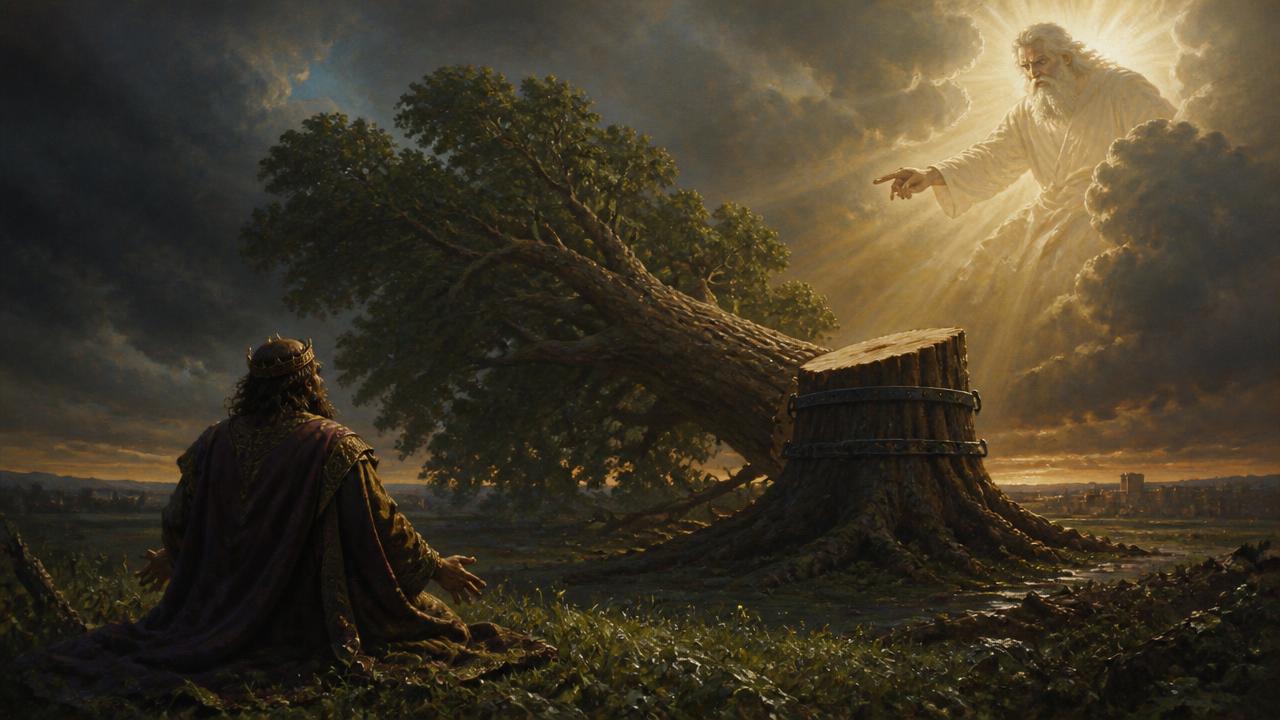
10Thus were the visions of mine head in my bed; I saw, and behold a tree in the midst of the earth, and the height thereof was great.
11The tree grew, and was strong, and the height thereof reached unto heaven, and the sight thereof to the end of all the earth:
13I saw in the visions of my head upon my bed, and, behold, a watcher and an holy one came down from heaven;
14He cried aloud, and said thus, Hew down the tree, and cut off his branches, shake off his leaves, and scatter his fruit: let the beasts get away from under it, and the fowls from his branches:
25That they shall drive thee from men, and thy dwelling shall be with the beasts of the field, and they shall make thee to eat grass as oxen, and they shall wet thee with the dew of heaven, and seven times shall pass over thee, till thou know that the most High ruleth in the kingdom of men, and giveth it to whomsoever he will.
30The king spake, and said, Is not this great Babylon, that I have built for the house of the kingdom by the might of my power, and for the honour of my majesty?
31While the word was in the king’s mouth, there fell a voice from heaven, saying, O king Nebuchadnezzar, to thee it is spoken; The kingdom is departed from thee.
32And they shall drive thee from men, and thy dwelling shall be with the beasts of the field: they shall make thee to eat grass as oxen, and seven times shall pass over thee, until thou know that the most High ruleth in the kingdom of men, and giveth it to whomsoever he will.
34And at the end of the days I Nebuchadnezzar lifted up mine eyes unto heaven, and mine understanding returned unto me, and I blessed the most High, and I praised and honoured him that liveth for ever, whose dominion is an everlasting dominion, and his kingdom is from generation to generation:
37Now I Nebuchadnezzar praise and extol and honour the King of heaven, all whose works are truth, and his ways judgment: and those that walk in pride he is able to abase.
Watch the scene first
A tree in the middle of the earth, tall enough to be seen to the end of the world, feeding and sheltering everything alive. Then a Watcher comes down from heaven and calls out the sentence: hew it down, cut off its branches, scatter its fruit — but leave the stump, banded with iron and brass, in the tender grass. "Let seven times pass over him." Twelve months later the king is walking on his palace roof, saying, "Is not this great Babylon, that I have built?" — and the word falls while the word is still in his mouth.
The anatomy of Babylon's disease
One sentence names the sickness this whole book is diagnosing: pride that annexes God's glory. "Is not this great Babylon, that I have built" is the Tower of Babel's ambition — "let us make us a name" — spoken by Babel's heir. It will be spoken again by the little horn with "a mouth speaking great things," and again at the end by a city saying in her heart, "I sit a queen, and am no widow, and shall see no sorrow." Babylon is not first a place. It is a posture.
What worship of self does to a person
The judgment fits the crime with terrible precision. A man who will not reflect the image of God is left to become the image of a beast: driven from men, eating grass like oxen, hair like eagles' feathers, nails like birds' claws. Scripture is showing you, in one royal biography, what happens to any creature who takes the place of the Creator — and why the last conflict is described as a choice between bearing a beast's mark and having the Lamb's name, His character, written in the forehead.
The stump is banded, not uprooted
Mercy is written into the sentence before the sentence falls. The tree is cut down but the stump stays, bound with iron and brass, waiting. Daniel even pleads with the king to break off his sins and show mercy to the poor, "if it may be a lengthening of thy tranquillity." Twelve months of grace pass before anything happens. Heaven's judgments in this book are never impatient.
The doxology of a humbled king
"At the end of the days I Nebuchadnezzar lifted up mine eyes unto heaven, and mine understanding returned unto me." The chapter closes with the most remarkable praise a pagan monarch ever wrote: God's works are truth, His ways judgment, "and those that walk in pride he is able to abase." This is the merciful version of the story. In Revelation, Babylon-the-system is offered the same mercy, refuses it, and gets the fall instead.
Check what you saw
Two questions on this scene. Answers show an explanation either way.
What does the tree in Nebuchadnezzar's dream represent?
What is the stated lesson of the chapter?
Talk it through
- —Why does the story spend so long on one king's pride?
- —Where do you see the 'tree' logic — growth mistaken for ownership — today?
Good prompts for a study group, or for the reflection journal on the Today page.