
Act I · Milestone 2 of 5
Daniel 3 — The Furnace
Told that his kingdom is only the head of gold, Nebuchadnezzar answers with a statue of gold from head to foot — and a death decree for anyone who will not bow.
Daniel 3 · about 9 minutes
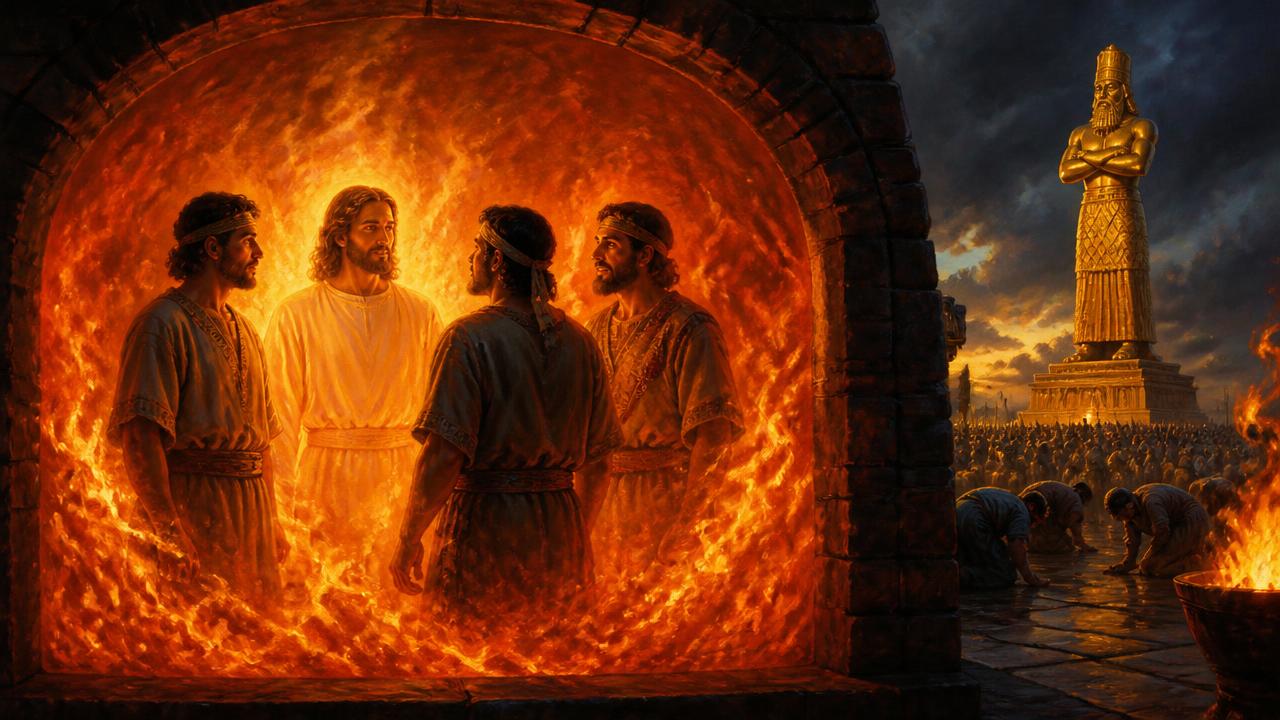
1Nebuchadnezzar the king made an image of gold, whose height was threescore cubits, and the breadth thereof six cubits: he set it up in the plain of Dura, in the province of Babylon.
4Then an herald cried aloud, To you it is commanded, O people, nations, and languages,
5That at what time ye hear the sound of the cornet, flute, harp, sackbut, psaltery, dulcimer, and all kinds of musick, ye fall down and worship the golden image that Nebuchadnezzar the king hath set up:
6And whoso falleth not down and worshippeth shall the same hour be cast into the midst of a burning fiery furnace.
16Shadrach, Meshach, and Abednego, answered and said to the king, O Nebuchadnezzar, we are not careful to answer thee in this matter.
17If it be so, our God whom we serve is able to deliver us from the burning fiery furnace, and he will deliver us out of thine hand, O king.
18But if not, be it known unto thee, O king, that we will not serve thy gods, nor worship the golden image which thou hast set up.
24Then Nebuchadnezzar the king was astonied, and rose up in haste, and spake, and said unto his counsellors, Did not we cast three men bound into the midst of the fire? They answered and said unto the king, True, O king.
25He answered and said, Lo, I see four men loose, walking in the midst of the fire, and they have no hurt; and the form of the fourth is like the Son of God.
28Then Nebuchadnezzar spake, and said, Blessed be the God of Shadrach, Meshach, and Abednego, who hath sent his angel, and delivered his servants that trusted in him, and have changed the king’s word, and yielded their bodies, that they might not serve nor worship any god, except their own God.
Watch the scene first
A plain outside Babylon. An image of gold, sixty cubits high and six cubits broad, gleaming in the sun. An orchestra. A herald who names the terms out loud: at the sound of the music, everybody falls down and worships, and whoever does not falls into a burning fiery furnace the same hour. The nations bow like a field of wheat in wind — and three men stay standing, visible from every angle.
The king is arguing with a dream
Chapter 2 told Nebuchadnezzar that his kingdom was the head of gold, and that the metals below him meant it would pass to somebody else. Chapter 3 is his rebuttal in bronze and gold: no silver chest, no brass thighs, no iron legs — gold all the way down. Babylon forever. The first golden image in this book is not in a dream; it is on a plain, and it is a policy. And the way it is enforced is worth noticing: not by persuasion, but by music, ceremony, social pressure and finally by law.
The most exact rehearsal of Revelation 13 in Scripture
Lay the two chapters side by side and the beats match, line for line. A state power sets up an image (Daniel 3:1 / Revelation 13:14). All peoples, nations and languages are commanded to worship it (3:4 / 13:7-8). Worship is enforced by public ceremony, then by economic and legal pressure, then by a death decree (3:5-6 / 13:15-17). A faithful minority refuses and is formally accused (3:8-12 / 12:10, 17). And they are delivered inside the crisis, not spared from it (3:25 / 14:12; 15:2). This is why Daniel 3 sits in the newcomer's on-ramp: it is the last conflict acted out in narrative, centuries early.
"But if not" — the creed of the faithful
Their answer to the king is the most important sentence in the chapter: "Our God whom we serve is able to deliver us from the burning fiery furnace… But if not, be it known unto thee, O king, that we will not serve thy gods." That is faith that worships God for who He is, not for what He prevents. It removes the one lever every persecuting power depends on — the assumption that people will finally bow to save themselves.
The fourth figure
Nebuchadnezzar counts three men bound and thrown in, then jumps up: "Lo, I see four men loose, walking in the midst of the fire, and they have no hurt; and the form of the fourth is like the Son of God." He does not watch the furnace from a safe distance. The only thing burned is the rope. Isaiah's promise — "when thou walkest through the fire, thou shalt not be burned" — walks on camera, and the king who wrote the death decree ends the chapter praising the God of the three who defied it.
Check what you saw
Two questions on this scene. Answers show an explanation either way.
What does the image on the plain of Dura demand?
What do the three men say about the outcome?
Talk it through
- —What makes worship enforced by law different from worship freely given?
- —How does 'but if not' change the way you read the rescue?
Good prompts for a study group, or for the reflection journal on the Today page.