
Act I · Milestone 1 of 5
Daniel 1 — Taken
Before a single vision, meet the man who received them: a teenager deported to Babylon, handed a new name, a new language and a new table — and quietly refusing to become someone else.
Daniel 1 · about 8 minutes
1In the third year of the reign of Jehoiakim king of Judah came Nebuchadnezzar king of Babylon unto Jerusalem, and besieged it.
2And the Lord gave Jehoiakim king of Judah into his hand, with part of the vessels of the house of God: which he carried into the land of Shinar to the house of his god; and he brought the vessels into the treasure house of his god.
7Unto whom the prince of the eunuchs gave names: for he gave unto Daniel the name of Belteshazzar; and to Hananiah, of Shadrach; and to Mishael, of Meshach; and to Azariah, of Abednego.
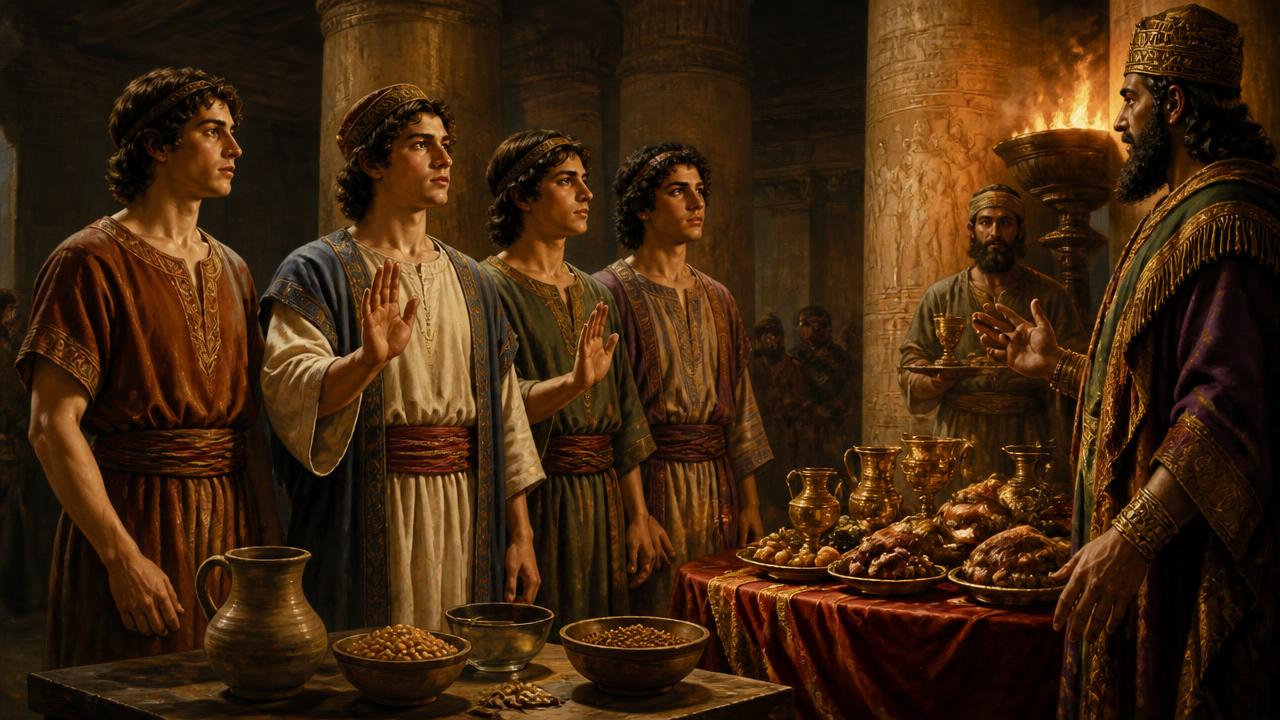
8But Daniel purposed in his heart that he would not defile himself with the portion of the king’s meat, nor with the wine which he drank: therefore he requested of the prince of the eunuchs that he might not defile himself.
12Prove thy servants, I beseech thee, ten days; and let them give us pulse to eat, and water to drink.
15And at the end of ten days their countenances appeared fairer and fatter in flesh than all the children which did eat the portion of the king’s meat.
17As for these four children, God gave them knowledge and skill in all learning and wisdom: and Daniel had understanding in all visions and dreams.
20And in all matters of wisdom and understanding, that the king enquired of them, he found them ten times better than all the magicians and astrologers that were in all his realm.
Watch the scene first
605 BC. Nebuchadnezzar's army closes on Jerusalem, and when it leaves it carries away two things: the vessels of God's house, set down in the treasure house of Babylon's god, and the brightest young men of Judah. Among them is Daniel. For three years these teenagers are to be re-made — Babylon's schooling, Babylon's language, Babylon's food, and Babylon's names. Then, one quiet sentence changes the story: "Daniel purposed in his heart that he would not defile himself."
The whole program is identity replacement
Look at what is actually being taken. Their names carried God's name — Daniel, "God is my judge"; Hananiah, "the LORD is gracious"; Mishael, "who is what God is?"; Azariah, "the LORD has helped." Babylon swaps every one of them for a name carrying a Babylonian god: Belteshazzar, Shadrach, Meshach, Abednego. The curriculum, the language and the king's table all point the same direction — assimilation. This is what Babylon always does in this book, and it never does it by argument. It does it by menu, music, schooling and reward.
A dietary test that is really a worship test
The request Daniel makes is modest and respectful: ten days, pulse and water, then compare. He does not lecture the prince of the eunuchs, he does not stage a protest, and he does not make his conscience anyone else's problem. But he does not eat. What is at stake is not nutrition; it is who gets to define him. Revelation will later describe a whole world made drunk with "the wine of Babylon" — false teaching poured out until people cannot tell truth from counterfeit. Daniel 1 is the first refusal of that cup, and it is refused by a captive with no leverage at all.
God vindicates the ones who let Him keep their identity
Ten days later their faces are healthier than the ones on the royal diet. Three years later, in a court full of trained scholars, the king finds them "ten times better than all the magicians and astrologers that were in all his realm." Notice the order of the text: the young men decide, and then God gives "knowledge and skill in all learning and wisdom; and Daniel had understanding in all visions and dreams." The prophetic gift of the rest of the book is handed to a young man who had already settled the small question of the dinner table.
Why the on-ramp matters before the visions
Every vision that follows — the statue, the beasts, the ram and goat, the seventy weeks — will describe empires that pressure conscience. Chapter 1 shows you, on a human scale, how that pressure actually feels and how it is survived: not by heroics in a crisis, but by a decision made in advance, in private, about who you belong to. That is the pattern the book will hold to the last page.
Check what you saw
Two questions on this scene. Answers show an explanation either way.
How does Babylon try to change Daniel and his friends?
Why does the book open with dated history instead of symbols?
Talk it through
- —Where does your culture rename or re-feed you before it ever threatens you?
- —Daniel asked rather than protested. When is that the stronger move?
Good prompts for a study group, or for the reflection journal on the Today page.