
Act III · Milestone 1 of 9
Revelation 1–3 — The Room
Before any seal is broken or trumpet sounds, John turns around — and the first thing Revelation shows you is not a beast but a Person, walking among seven lampstands.
Revelation 1–3 · about 16 minutes
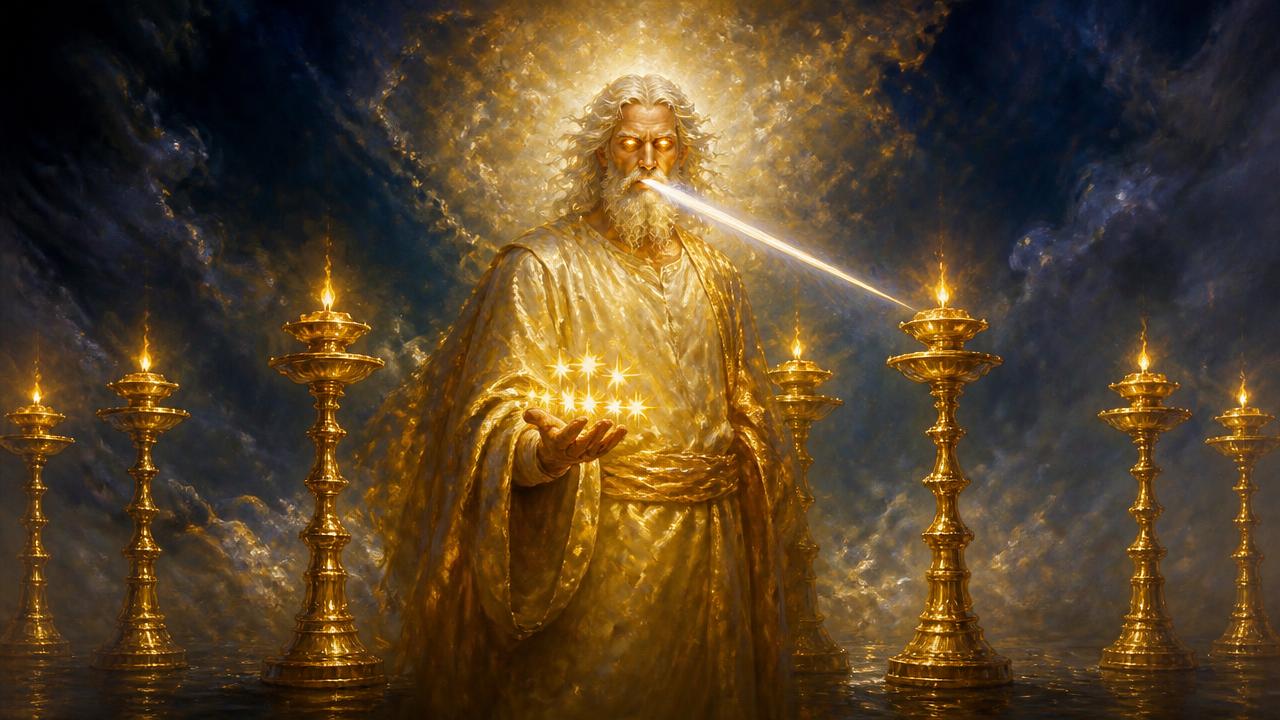
12And I turned to see the voice that spake with me. And being turned, I saw seven golden candlesticks;
13And in the midst of the seven candlesticks one like unto the Son of man, clothed with a garment down to the foot, and girt about the paps with a golden girdle.
14His head and his hairs were white like wool, as white as snow; and his eyes were as a flame of fire;
15And his feet like unto fine brass, as if they burned in a furnace; and his voice as the sound of many waters.
16And he had in his right hand seven stars: and out of his mouth went a sharp twoedged sword: and his countenance was as the sun shineth in his strength.
17And when I saw him, I fell at his feet as dead. And he laid his right hand upon me, saying unto me, Fear not; I am the first and the last:
18I am he that liveth, and was dead; and, behold, I am alive for evermore, Amen; and have the keys of hell and of death.
20The mystery of the seven stars which thou sawest in my right hand, and the seven golden candlesticks. The seven stars are the angels of the seven churches: and the seven candlesticks which thou sawest are the seven churches.
20Behold, I stand at the door, and knock: if any man hear my voice, and open the door, I will come in to him, and will sup with him, and he with me.
Watch the scene first
John is exiled on Patmos, and he hears a voice like a trumpet behind him. He turns — and sees seven golden lampstands, and in the middle of them 'one like unto the Son of man.' His hair is white as wool, His eyes like flame, His feet like brass glowing in a furnace, His voice like many waters. Seven stars sit in His right hand, a two-edged sword comes from His mouth, and His face shines like the sun at full strength. John falls at His feet as dead. Then the hand touches him: 'Fear not; I am the first and the last: I am he that liveth, and was dead.'
The Bible names its own symbols again
Just as Daniel named the head of gold, Jesus names the first two symbols outright: 'the seven stars are the angels of the seven churches: and the seven candlesticks which thou sawest are the seven churches' (1:20). You never have to guess. Lampstands are churches; stars are their messengers; and Christ is not distant — He walks among them. Revelation opens by showing you where Jesus actually is: in the middle of His people, across the whole sweep of the church age.
Seven letters, one long road
Chapters 2 and 3 are seven letters to seven real churches of Asia Minor — Ephesus, Smyrna, Pergamos, Thyatira, Sardis, Philadelphia, Laodicea. Read in order, they also trace the journey of the church through history: the first love cooling, the age of persecution under pagan Rome, compromise as the church is wed to worldly power, the medieval 'Jezebel' corruption, the dead formalism of the Reformation's later years, the open door of the great missionary era, and finally the lukewarm self-sufficiency of the last church — which thinks it is 'rich, and increased with goods, and have need of nothing' while heaven calls it 'wretched, and miserable, and poor, and blind, and naked.'
The same heartbeat as Daniel
Notice what this opening does that Daniel never stops doing: it anchors everything in the courtroom of heaven before showing you the conflict on earth. Daniel 7 showed the judgment seated before the little horn's end. Revelation 1–3 shows Christ officiating among His churches before any trumpet sounds. The pattern is the same — heaven's side of the story first, so that when history gets dark you already know who is walking in the middle of it.
The letter that is still open
Laodicea is the last letter, and it is still being written. To a church that is neither cold nor hot, Christ does not threaten from inside — He knocks from outside: 'Behold, I stand at the door, and knock.' The last appeal of Jesus to His church is not condemnation but a dinner invitation: 'if any man hear my voice, and open the door, I will come in to him, and will sup with him, and he with me.' The whole book that follows is written to a people being woken up in time.
Check what you saw
Two questions on this scene. Answers show an explanation either way.
Where is Christ standing in the opening vision?
What kind of writing are chapters 2–3?
Talk it through
- —Why start a book about world history with seven local churches?
- —Which letter reads most like your own moment?
Good prompts for a study group, or for the reflection journal on the Today page.