Revelation 6
King James Version · 17 verses · tap a verse for its study panel
Listen to Revelation 6
The full chapter read aloud in a natural voice.
What the verse says and what it means. One reading, no tabs. Saved in this browser.
The chapter exposition
Revelation 6 — seen whole
The chapter read as one picture before any verse is opened: what the scene shows, where it sits in the continuous story, and the chain references that hold it to the rest of Scripture.
3.4 Revelation 6–7 — The Seals: Conquest, Decline, and the Sealed People
The opens the seals: the church’s history under the same eras as the churches — now told as the consequences of fidelity and apostasy.
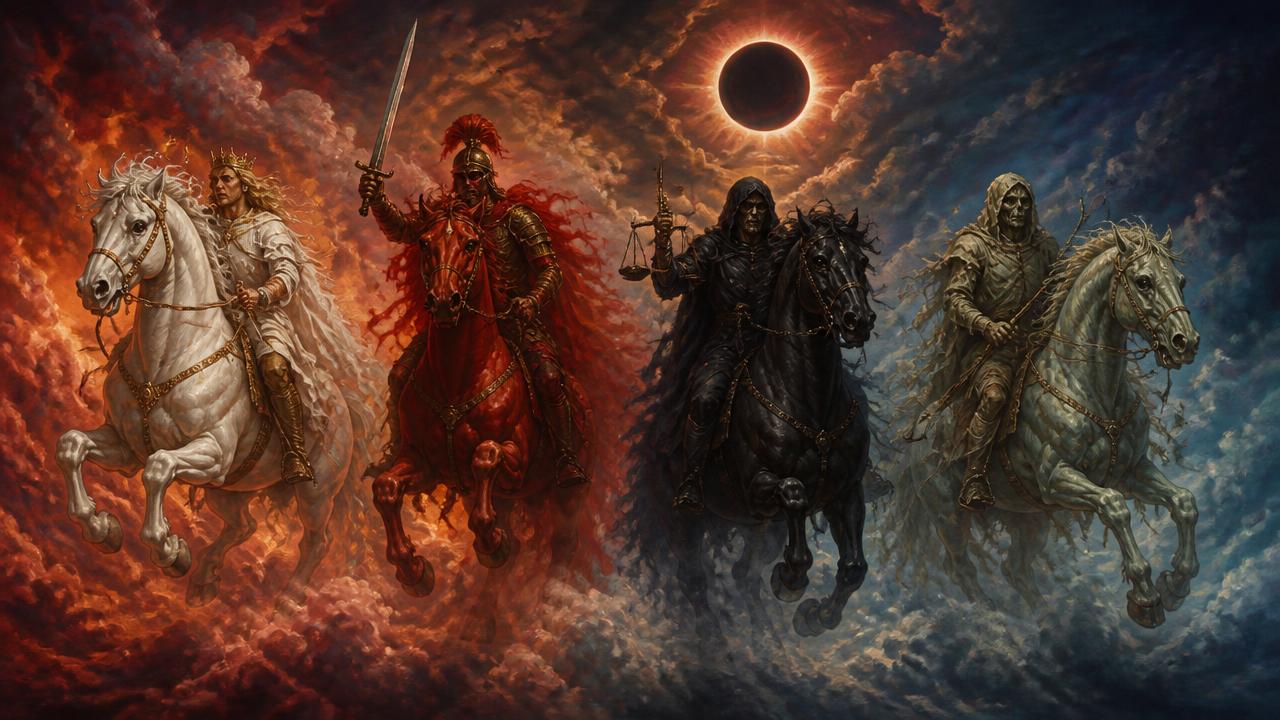
White horse — “conquering, and to conquer”: the apostolic gospel’s pure charge (cf. the same imagery redeemed in 19:11).
Red horse — peace taken from the earth: the martyr era’s sword.
Black horse — famine scales, wheat at a denarius: compromise — the era of Pergamos; the Word weighed out scarce, “a famine… of hearing the words of the LORD” (); yet “hurt not the and the wine” — the Spirit and the blood preserved among the faithful.
Pale horse — Death riding, Hell following: the medieval apex of apostasy-plus-persecution. The Anatomy of Apostasy synthesis (Aug 10, 2026): the red, black, and pale horses are the construction stages of the harlot — “the other three horses are the counter-gospel that builds the scarlet of Revelation 17… by the time we get to Revelation 17, three horses have merged into one terrifying entity”; and the pastoral addition: “that pale horse is . But remember — Babylon has daughters.” The seals and the harlot are one storyline at two magnifications.
Fifth seal — crying “How long?”: the martyrs’ blood, in sacrificial idiom (blood poured at the altar’s base, Lev 4:7), personified as Abel’s was (Gen 4:10) — not conscious spirits but covenant testimony demanding judgment; white robes given, rest “for a little season” — the Reformation era’s vindication begun, completion awaiting the judgment.
Sixth seal — the signs: the great earthquake (Lisbon, 1755), the dark (May 19, 1780), the falling (November 13, 1833) — the sequence Jesus gave in , in order, in the generation before the judgment hour opened in ; then the heavens departing as a scroll — the Second Coming’s terror for the unready: “the great of his wrath is come; and who shall be able to stand?” (6:17).
Revelation 7 is the answer to that question. Four angels hold the four (war and strife, Jer 49:36–37 — “satanic destruction via political strife” restrained) “till we have sealed the servants of our God in their foreheads.” The full doctrine of the sealed 144,000 is in Part IV §4.5; here, the structural point: between the sixth seal’s signs and the seventh’s silence, heaven’s whole business is sealing a people who can stand. The great multitude “which no man could number… out of great tribulation” (7:9–14) stands before the throne with palms — the harvest of every era beside the final sealed company.
Seventh seal — “silence in heaven about the space of half an hour” (8:1): heaven emptied for the escort of the King; the seals end where history ends.
OT roots. ; 6 (the four horses) · Lev 4:7; Gen 4:10 (blood at the altar) · ; Isa 34:4 (the signs) · Eze 9 (the sealing in the forehead — the man with the writer’s inkhorn, the pattern text) · Gen 41 (Joseph’s sealed granaries before the famine).
Drawn from the same framework published on The Foundations.
How this chapter is read
The symbol keys and study principles that govern this chapter. Every conclusion is checked against Scripture — follow the references and read them for yourself.
Symbol keys · 6
White Horse
The Word of God going forth in purity and power
Basis: Revelation 6:1-2 describes the rider on the white horse as going forth to conquer, symbolizing the spread of the gospel
White horse in Revelation 6
The word of God going forth
Basis: Revelation 6:2 describes the rider on the white horse as conquering, paralleling the spread of the gospel
White horse
The early church going forth with the gospel
Basis: Revelation 6:2 describes the rider going forth conquering and to conquer
Souls under the altar
The lives of the slain martyrs, poured out like sacrificial blood and crying for justice
Basis: Genesis 2:7 defines the soul as the whole living person; Leviticus 4:7 pours the victim's blood at the altar's bottom, the figure behind 'under the altar'; Genesis 4:10 shows blood crying from the ground; Ecclesiastes 9:5 shows the dead have no consciousness
Red horse
Persecution of the church by the Roman Empire
Basis: Revelation 6:4 describes the removal of peace and persecution
Red horse
Persecution
Basis: Revelation 6:4 describes the red horse as taking peace from the earth, symbolizing persecution
Study principles · 3
The seven seals are connected to the sanctuary service and highlight the unfolding of God's covenant with His people. The seals begin at the table of showbread, emphasizing the Sabbath and the covenant relationship.
The seven seals, trumpets, and churches in Revelation parallel each other and represent periods of time rather than singular events. Each series covers a span from Pentecost to the Second Coming, showing the progression of the church and the unfolding of prophecy.
The seals unfold in connection with the table of showbread, symbolizing the word of God. The seals are linked to the word of God going forth, as seen in the rider on the white horse representing the pure gospel.
Revelation 6 — the full dossier
The long-form file on this chapter: the history behind it, the earlier Scripture standing under it, its symbols and chain references, where its principle is visible today, and the objections that attach to it. Three registers are kept distinct — documented history, internal biblical parallel, and interpretive correspondence.
The dossier is research-grade and runs 1,500 to 2,500 words. It opens at the Scholarly reading level, alongside the Old Testament roots, the present-day threads and the objections.