
Revelation 21
King James Version · 27 verses · tap a verse for its study panel
Listen to Revelation 21
The full chapter read aloud in a natural voice.
What the verse says and what it means. One reading, no tabs. Saved in this browser.
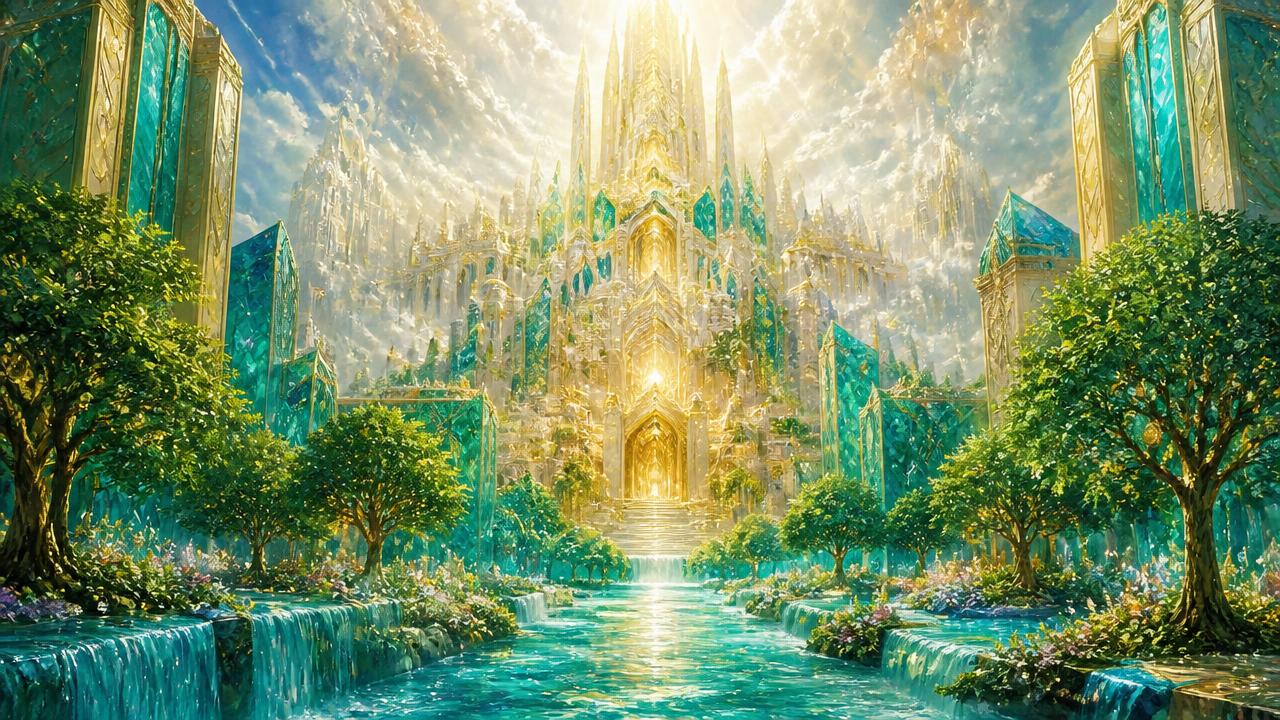
The chapter exposition
Revelation 21 — seen whole
The chapter read as one picture before any verse is opened: what the scene shows, where it sits in the continuous story, and the chain references that hold it to the rest of Scripture.
3.14 Revelation 21–22 — Eden Restored: The Story Comes Home
“And I saw a new heaven and a new earth… And I John saw the holy city, new Jerusalem, coming down from God out of heaven, prepared as a bride adorned for her husband. And I heard a great voice out of heaven saying, Behold, the tabernacle of God is with men, and he will dwell with them” (21:1–3) — the ’s whole logic consummated: the God who asked for a tent “that I may dwell among them” (Ex 25:8) moves in permanently. No more tears, death, sorrow, crying, pain — “the former things are passed away.” The city itself is the sanctuary’s final enlargement: foursquare like the Most Holy Place, gold like its walls, twelve foundations (apostles) and twelve gates (tribes) — the two covenant communities as one architecture; “and I saw no temple therein: for the Lord God Almighty and the are the temple of it” (21:22) — the shadow retired because the Substance is present.
And Eden, item by item, restored with interest: the river of water of life (Gen 2:10 → 22:1); the tree of life (Gen 2:9; 3:22–24 → 22:2 — now on both sides of the river, its leaves “for the healing of the nations”); the curse revoked (“and there shall be no more curse,” 22:3, closing Gen 3:17); the lost dominion returned (“they shall reign for ever and ever,” 22:5, restoring Gen 1:26); and the lost face-to-face: “and they shall see his face; and his name shall be in their foreheads” (22:4) — the sealed forehead’s final meaning: not a doctrine passed but a likeness restored. “Only the garden-hearted enter the garden” (The Seal, the Spirit, and the Time of the End, 2026) — the righteous dwell with everlasting burnings (Isa 33:14–15) because God’s unveiled presence is the fire in which love is at home.
The book signs off with the tempo of the whole corpus: “Behold, I come quickly” three times; the Spirit and the bride saying Come; a last blessing on “they that do his commandments, that they may have right to the tree of life”; and the final invitation left open on purpose — “whosoever will, let him take the water of life freely” (22:17). Daniel was told to seal his book; John is told, “Seal not the sayings of the prophecy of this book: for the time is at hand” (22:10). The app exists inside that unsealing.
OT roots. Gen 1–3 (the whole restoration ledger) · Ex 25:8 (the tabernacle’s purpose fulfilled) · Isa 25:8; 35; 65:17–25 (no more death; the new earth) · Eze 40–48 (the city-temple vision) · Isa 33:14–17 (dwelling with the fire; seeing the King).
Drawn from the same framework published on The Foundations.
How this chapter is read
The symbol keys and study principles that govern this chapter. Every conclusion is checked against Scripture — follow the references and read them for yourself.
Symbol keys · 3
Symbol
The golden gates of the city. symbolizes the access to eternal life and the fulfillment of God's promises. Basis: Revelation 21:10-12 describes the New Jerusalem, highlighting the significance of the gates.
New Jerusalem
The ultimate restoration and dwelling place of God's people
Basis: Revelation 21 describes the new Jerusalem as the culmination of God's plan for a renewed creation
Feast of Tabernacles
God's dwelling with humanity
Basis: Represents the ultimate fulfillment of God's promise in Revelation 21
Study principles · 4
The concept of 'new heaven and earth' can be understood both literally and symbolically. Prophets like Isaiah and Ezekiel use this language to describe both the physical restoration of Jerusalem and the ultimate spiritual renewal in the end times.
Isaiah 65:17Revelation 21:1The presence of God is a source of joy and transformation for the redeemed. In His presence, the redeemed experience love, peace, and the fullness of joy, which is essential for their eternal state.
Revelation 21:42 Corinthians 6:16The Feast of Tabernacles symbolizes God's dwelling with humanity in the new creation. This feast represents the ultimate fulfillment of God's promise to dwell with His people.
Lev 23:33-43Rev 21:3The counterfeit kingdom of Babylon in Revelation is a parallel to the true kingdom of God, represented by New Jerusalem. This highlights the ongoing cosmic conflict between good and evil, where Satan attempts to mimic God's kingdom.
Revelation 21 — the full dossier
The long-form file on this chapter: the history behind it, the earlier Scripture standing under it, its symbols and chain references, where its principle is visible today, and the objections that attach to it. Three registers are kept distinct — documented history, internal biblical parallel, and interpretive correspondence.
The dossier is research-grade and runs 1,500 to 2,500 words. It opens at the Scholarly reading level, alongside the Old Testament roots, the present-day threads and the objections.